When did you first become drawn to studying plants and animals?
Sylvia Earle: I’ve loved working with plants and animals, thinking about them, and the idea of working them for a lifetime goal, ever since I can remember. I think most children are attracted to critters of all sorts. You just see a two or three year-old child encountering a grasshopper or a caterpillar. Unless someone has frightened that child into not touching it, the natural thing is to express the curiosity that is inherent in most young things and check it out. I was very lucky I think. My parents used to bring frogs over for my brothers and me to get to know. But we were very carefully told always to put them back in the pond where they were found. Or to allow a caterpillar to gently walk across your hand, and not to disturb them, because you might get stung by some of their bristles. I learned very early on that if you show respect for other creatures, they won’t go out of their way to harm you. I grew up more or less fearless with respect to all sorts of things — spiders, squirrels, birds, mammals — because of the gentleness that both my father and my mother and my family in general expressed toward our fellow citizens on the planet. That empathy for living things became naturally expanded as I grew up into a study of living things. I became a biologist just following my heart, I suppose. I couldn’t imagine wanting to do anything else.
Describe the places you grew up in as a kid, and how they inspired you and kind of encouraged this life work.
Sylvia Earle: As a small child I lived on a farm in New Jersey. Both my parents grew up on farms, and therefore understood the importance of rain. Sometimes rain could be a nuisance because it interrupts picnics and things like that, but by and large you welcome rain because it’s important for plants to grow. You need it in order for crops to grow and produce. So I came to enjoy walking in the rain. And oh, the power of a storm! Instead of being frightened, I really enjoyed it. At night, I can remember pressing my nose against the glass of the window and watching the trees outside and thinking how marvelous it was. I think my childhood was especially happy. I understand that many do not have the kind of special early period in their life that I did. Part of it was because my parents really made me feel special, made me feel loved. And my brothers, and the rest of the family. But I always felt, even as a small child, that I couldn’t do anything so bad that I couldn’t come home, and that it would be all right. Somebody would take me in their arms and I would be reassured that it would be okay. We’d figure out some solution to whatever problem there might have been. Early on, there was an opportunity, because of the neighboring woods, to explore quite a lot on my own, and I did. I would just spend a lot of time out in the nearby woods, and feel such sympathy, such… I feel so sorry for those who don’t have an opportunity in their early years to go out on their own. Sometimes with others, but really by yourself, to go out and just see what’s going on. Find out what’s under that bush, or what is around the other side of that tree. And not feel afraid. Quite the contrary. I almost can’t stand not knowing.
When did you become interested in the ocean and sea life?
Sylvia Earle: As a child the family used to go down to the New Jersey shore for vacations. We didn’t live near the beach, but it wasn’t that far away. New Jersey is a relatively small state; nothing is very far from anything else. I think in my earliest years, the ocean became particularly special because it wasn’t there all the time, I never took it for granted. It was a very special treat.
They say that in some countries such as Peru, they worship the sun because they only see it when the fog breaks, and they see the sun. I didn’t exactly worship the ocean, but I really regarded it as a very special opportunity. I can remember, as we traveled across the pine barrens, we came to the sand dunes along the shore, before we could see or hear the ocean, I could smell it. And then hear it. And then finally, there it was, this great incredible expanse. And I can still feel that leap of enthusiasm, and real joy, at the prospect of finally getting out to the beach, and running around.
The most important thing, to me, aside from the freedom and the power of it, was the kind of creatures that you could see along the beach that you can’t find anywhere else. I remember the big horse-shoe crabs for example. I thought they were just charming, most people think they’re old ugly beasts. Maybe that’s part of their charm. They look so strange, but absolutely harmless. Because of the early opportunities to get to know creatures and realize that they really weren’t out to bite me or hurt me. If I approached them with gentleness they would respond with gentleness. I found myself, even as a very small child, playing with these big horse shoe crabs, and people coming by and wondering at this little kid fooling around, not hurting them, but just really curious about what made them move. Some of them would seem to get stranded on the beach, and I used to entertain myself by struggling to pick them up, and turn them around and send them back into the sea.
Not realizing that they were supposed to come up on the beach and lay their eggs.- I thought I was doing a good thing anyway.
You must have been a very self-contained child. You were able to occupy yourself and entertain yourself really just being alone with nature. That’s unusual.
Sylvia Earle: I never thought it was unusual to feel self-contained, or to entertain myself for long periods of time with nature. It’s endlessly fascinating. You never know what you were going to see, and it changes all the time, even the same place every minute is different. The wind blows, the trees move, butterflies come in, somebody takes up and leaves. You see birds come by, it’s just constantly changing. And endlessly fascinating.
It sounds like it was always clear to you that you would become a scientist. What about the focus on marine biology? When did it first occur to you that that’s what you wanted to do.
Sylvia Earle: When I was twelve, my parents moved from New Jersey to Florida. We lived right on the water. My back yard became the Gulf of Mexico. So instead of going out to climb trees and watch the squirrels and otherwise have the fun of being out in the hills, I had the pleasure of getting acquainted with salt marshes, and sea grass beds, which were populated with things such as sea horses and sea urchins, and great crabs with long, spindly legs that were absolutely fascinating. You never knew what you were going to find just walking around in these squishy, but beautiful, clear water areas. That used to be a place that lived up to its name. It’s called Clearwater. At the time I was there as a child it had clear water. It isn’t quite that way anymore.
And so you really had a vision of doing this as a profession, as early as twelve?
Sylvia Earle: When asked as a child “What do you want to be when you grow up?” I didn’t know exactly what to call it, but I did know that I wanted to do something that related to plants and animals. I think for a while I entertained the thought that maybe I wanted to be a veterinarian. I knew about veterinarians, and I loved cats and dogs and horses, and all the traditional kinds of creatures that human beings surround themselves with. But I was increasingly interested, fascinated, and really enchanted by the wild creatures. As I grew older and learned more about them, I think I determined that was the direction I would be taking.
The decision to really focus on marine science took a while. Not because I didn’t love it, but I loved everything else as well. It was hard to actually say, “I will just study fish, I will just study birds. I will concentrate on this narrow discipline.” What caused me to focus on marine plants was the inspiration of my nature professor, Harold Humm. He introduced me to the beauty and the interest and the good common sense of looking at plants. By knowing the plants, you get some feel for how the whole system works. Plants provide shelter, whether it’s underwater or above. They provide food. They provide the energy that supplies a whole interacting system. So if you know the plants, you get a good cornerstone on how all the rest of the system works. When I was still an undergraduate student at Florida State University, I began my life-time project with that as a starting point. I am still working on it, and expect to continue working on it. If I had ten lifetimes, I’d still be working on that same project, I’m sure. It’s just to explore the plants in the Gulf of Mexico. That’s not the whole world, it’s just one rather substantial body of water that is mostly in the waters of the United States and Mexico, with the Caribbean islands to the south. But it is an endlessly fascinating, forever changing body of water. There are certain patterns that you can find and expect, but every day is different, every minute is different.
At first, I thought I couldn’t possibly learn anything new, it’s all there in all those libraries filled with books. I thought there was nothing I could add to this body of knowledge. Quite the contrary. There is so much that we do not know. Each of those books represents a door that can lead you to hundreds, thousands of questions. There are plants growing where people didn’t expect to find plants. That leads to a whole host of questions. Why is this so? Why do they occur here? Why don’t they occur somewhere else? Who eats them? Are they there throughout the whole year? How far do they range? It could take ten lifetimes. You never run out of questions to ask.
You’ve mentioned the books that you studied. Were there any particular books that you remember being very inspiring when you were young?
Sylvia Earle: I fell in love with the stories by William Beebe, who was an ocean explorer. He discussed what it was like to go down inside a submersible, and peer out of a port hole and see beautiful, luminescent fish, with lights down the side like ocean liners. Bizarre creatures of the sort that you just don’t see walking down the street, or going into the forest, or even looking around in shallow water. The aquariums of the world, as wonderful and diverse as they are in terms of the creatures they show, do not have the sort of creatures that Beebe described from his exploration back in the 1930’s. And that certainly, I found utterly inspiring.
For a long time I did not really like fiction at all. I was really hooked on looking in encyclopedias, because that I could trust. I thought that this was something that was for real. I later became aware of the great truth that can be conveyed in fiction, and the beauty in poetry. And so I have made the transition, not totally away from the non-fiction works by any means, but to expand my horizons.
In my early childhood, I enjoyed science fiction perhaps, and fairy tales and the stories that one grows up with. A lot of animal stories. But this evolved into a long era when I absolutely wouldn’t read anything except things like the stories by Beebe. That was real, and that was the adventure. And nothing could touch the truth. And that’s true. Nothing can. But you can convey truth in many ways.
You’ve said you used to amuse yourself reading the encyclopedia. How old were you at that time?
Sylvia Earle: Before my family moved to Florida, so it was before I was twelve. It was like a discovery. You never knew what new things you were going to find on every page. It was a bit like walking out in the woods. Around every bush there was something new. Turn a page in a book, and a-ha! Another new discovery. New for me anyway.
What kind of student were you as a kid?
Sylvia Earle: I probably would be regarded as somebody a little on the boring side again, because I really loved school. I just again felt this joy of discovery. I was like a big sponge, absorbing as much as I could. And I enjoyed succeeding. I liked it when I could get my mind around the math problems. It was a sense of accomplishment, that I could figure things out. It was the joy of success. Like a flash of light in your brain, an insight that you have derived from getting this piece of information and that piece of information, and put them together, and independently come up with something else. I never did and still don’t tire of that kind of sheer joy.
You graduated from college quite early. You just sort of breezed through it?
Sylvia Earle: I finished high school when I was 16. In part, that was because I started school straight away in the first grade at the age of five. I didn’t skip anything or compress anything. My brother and many of my classmates also went through the routine and came out the end of high school at sixteen. My birthday is at the end of August, and I just turned five before school started, so I was often the youngest in class. That set me apart a bit, and may be why some would say I was a loner. I enjoy the company of others, but I never was unhappy alone. I enjoy my own company. I enjoy having time to just walk around and think. I treasure the times when I’m out on my own on the water, or in the woods, or anywhere. It’s a special kind of peace. I think it’s the security that my parents instilled at a very early age. I felt good about myself and I think that has stuck.
So many people are afraid to be alone. That is like the absolute worst hell to go through.
Sylvia Earle: I suppose some people, many people, are afraid of being alone. But, for example when I go into the forest, I am not alone. There is life all around. If I go into the sea by myself, and I do it a lot, there is life everywhere. I feel sorry, I think, for astronauts who, if they were abandoned, if they were all by themselves on the moon, because that would be truly, truly alone. When Buzz Aldrin and Neil Armstrong were on the moon, they were alone. The closest living creature was Mike Collins out there in the spacecraft that was orbiting the moon. The next stop was earth. Underwater, every spoonful of water is filled with life. You are really never alone, it just depends on your perspective.
I know your parents lost several children before you were born. I wonder if that tragedy might have affected the way they related to you, in that very special relationship that you described.
Sylvia Earle: My two brothers and I constituted a second family, in quotes, that my parents had. They lost the first four children, all boys. I think that they may have been a little more lenient with my older brother, with me, and with my younger brother, than they might have been with the first four children. Maybe not. I do know that they seemed to trust me, and trust my judgment from a very early time. They had confidence in me, and they certainly made it clear that they loved us. They really cared about us and were very gentle, not just with cats and dogs and grasshoppers and such, but with us. That has probably made a tremendous difference in my outlook on others, and my own children and life in general. An attitude of respect.
I would have expected them to be overprotective.
Sylvia Earle: One would imagine that having lost several children, that they might be overly protective of me and my brothers. But it didn’t work that way. I think that they had seen enough, and been philosophical about the unpredictable aspects of life. Anyway, they were not. They have always been there. I never felt abandoned at all. I always knew that I could rely on them for support, for love, for caring. But I never felt smothered. I never felt that if I really wanted to do something that they would say, “no way, kiddo.” Rather that they would say, let’s see what we can do to make it happen. My parents were not financially able to support my brothers and me in school. We had to figure out a way to help ourselves. They helped as best they could, but it was not possible to pay big tuition. But they never said no. They said, let’s see what we can do, let’s find out. They took a loan, and helped during my early school years at Florida State University. I worked, and I got a scholarship when I went to Duke. They helped every step of the way. They have been just tremendously supportive.
What kind of work did you do to support yourself during school?
Sylvia Earle: Well, I say that I worked when I went through school, but it wasn’t to me work. It was really a source of pleasure. I worked as a laboratory assistant, and it was throwing me right into the midst of the very people that I wanted to be with. And never mind that I was washing glassware, and whipping up banana medium to feed the fruit flies and things and things of that sort. I found it just that… that I was with the people I most admired. It gave me an entree. It gave me experience. It gave me acceptance with them – I became the lowliest member of the team, but part of the team.
Even though I was a student, I was put in that category of people who are serious about what it is that they also were serious about. So that, I think that was very helpful, that from the earliest time going to school, I think I was recognized as someone who really intended to go on and do something more than just get out of that class as fast as I could, and on to something else. That I really wanted to use this towards some as yet undefined way, but to make it meaningful.
What kind of educational background did your parents have?
Sylvia Earle: My parents both went through grade school. My mother finished high school, my father did not. My mother was trained as a practical nurse. My father was a natural engineer, I suppose, and electrical engineer. He worked for DuPont for 28 years. Just short of retirement he moved to Florida and struck out on a second career. He went off on his own as an independent contractor, and became one of those individuals who creates the life-blood of America, a small business. He supported himself, and a team of others. It became known as Earle Electric. My younger brother took over that business, and still operates it in Florida.
So, they didn’t have heavy educational backgrounds, but they obviously appreciated the value of education.
Sylvia Earle: Absolutely true. My parents have always appreciated the importance of an education. My mother had five sisters, six girls in all. My grandfather on her side was also a self-trained engineer. They all had respect for teaching and for learning. My grandmother stayed at home, but she was really a teacher to this whole family of young ladies. On my father’s side there were 11 children. My father was the next to the youngest. They were a very lively family that really had a good time with one another. Every summer, 20 or 30 members of the family would get together for a big picnic. I had cousins all over the place. I knew that I was a part of this great Earle-Ritchie clan. It was a good feeling. So many families do not have that warmth and that mutual respect. They fight a lot, they have very hard feelings, and very intense rivalries. I escaped that somehow. Not that there weren’t some rivalries and some hassles from time to time, but, I have in general the recollection of a very happy childhood. Lots of fun. A lot of joy.
We’ve talked about your breezing through high school and college, but actually it took you seven years to get your doctorate. I know there were several interruptions along the way. How did you manage to balance career and family?
Sylvia Earle: I didn’t zoom through high school. I got out at the age of 16, and went on to finish my Bachelor’s degree by the time I was 19. And then a Master’s by the time I was 20. Then I didn’t exactly slow down, but I began to broaden the interests into some other areas. There was a point where I thought, I’ve had enough of books, what I really want to do is study the real thing. I want to get out in the water, I want to see fish, real fish, not fish in a laboratory.
I also was attracted to a fellow student, when I was at Duke. And the upshot of all that is that we got married. My new husband almost immediately was swept away aboard a ship to the Mediterranean, and was gone for several months. I had an opportunity to go to work, and get to see real fish, not fish in a book.
For about six months I had a job working with the U.S. Fish and Wildlife Service down on the coast of North Carolina. I knew that I wanted to go back to school and finish my degree, but my attention turned to being married and having a family. In the next few years, two children arrived, but I was able to continue work on my Ph.D.
We moved to Florida, and I went to the University of Florida at Gainesville. Once again, I took a job in the same department where I was taking classes. It certainly helped financially, but I think even more, it helped put my feet solidly on the ground, becoming tuned into what the real professionals were doing in that area. They accepted me as a part of their team, if you will. I learned so much just from being there on a day-in day-out basis, not just as a student.
I took a long time to finish up a formal program for dissertation. It was only possible because my nature professor for the Masters degree agreed to take me back as a doctoral student, even though I was living in Florida. I had enough course work during my time at Gainesville, and before I left Duke University, so that most of what I had to do could be done from a distance. But I did have to pass the necessary examinations that are required. Having been out of some of the classes for some time, it meant that I really had to do some independent study to catch up. So much had been learned in such a sort time in areas such as genetics and physiology that I had to squeeze a lot of condensed effort into a few weeks, a few months actually prior to actually taking the exams.
I was so pleased when it really worked. I took the exams and I passed them. What remained then was to take the accumulated effort of 13 years of work and put this together in a formal presentation, which was the dissertation. But having passed these exams and so on, there was yet another opportunity to go off and be the botanist aboard a research vessel for about six weeks as part of the International Indian Ocean Expedition. I was not aware at the time that I was the only woman who had been invited to come aboard. I wasn’t invited as the only woman, I was invited as the only botanist. The rest were mostly zoologists or crew members. A
I have tucked away in my filing somewhere, a headline, a newspaper clipping, that I cherish. Because it was such fun. We had to depart from Mombassa, in Kenya. Someone got wind of the fact that there was a woman aboard this research vessel. This was 1964, before it was more or less traditional. It was okay for women to go, but was certainly not traditional for women to do such things. The reporter came down, and I was excited about talking with him about what we were going to do scientifically, and all he wanted to talk about was, what’s it going to be like out there, with all those men? And the headline reads: “Sylvia Sails Away With 70 Men, But She Expects No Problems.” There were no problems. It was great fun. It was really a delight. It’s not all bad being a woman in this field.
A lot of women are struggling to combine career and family. You read about achievers in different fields who decide to have kids at age 40. As you talk about forming your family, you are also talking about your excitement about your career. Was that never a problem?
Sylvia Earle: It is a problem trying to combine having family and being as enthusiastic about a specialty as I have always been. I have managed it in part through ingenious rearranging of a life, I suppose. Having a laboratory set up at home. I always had a microscope — not a big, fancy, sophisticated microscope, but something that would make it possible for me to work at home. And I have a professional library that I have accumulated all my life. The big professional libraries do provide the necessary access to a world of information, but I have managed to gather a nucleus of books at home that are like an extension of my mind. My favorite wall paper is books. I can’t possibly keep everything in my brain, but if I have access to it, and know where to get it off the shelf, that’s like having an extension — a bigger brain. That’s certainly true with computers now. Like the sign reads over the library at Florida State University: “The Half of Knowledge is Knowing Where to Find Knowledge.” I know where on my shelf to find certain things or where, by hitting the buttons on a computer to call up something. And its a tremendous kind of richness to have that kind of wealth of information available.
You have implied in previous interviews that your scientific expeditions may have led to the dissolution of your first marriage. Do you think that’s the case?
Sylvia Earle: It’s hard to have a traditional kind of relationship when you are as motivated, I suppose, as I have been — compelled, I suppose you could say — to stay involved with the cutting edge of certain kinds of exploration. It’s, for me, irresistible, and certainly not meant ever to be an either-or choice, or to be competing with anyone. That’s not the point at all. I can’t help it! I suppose there are musicians who can’t help themselves, they just have to do certain things — or writers or poets. I can’t turn my mind off, just stop the curiosity that is I suppose inherent in all children and all scientists. It’s just there. I think it’s there in all human beings, but maybe a slightly more liberal dose with most scientists and all children. Why things come apart, I simply don’t know. I love being with someone. I love having a home, love cooking, love all the things that are traditional in a housewife-mother kind of situation. I certainly have loved my family, and have really no good sound explanation for why it did not work in terms of a long-term enduring relationship. But it does put a strain on things when one or both partners have a way of having strong interests that aren’t always side by side. Or sometimes even when they are. So I think that one of the reasons that currently it is more difficult for people to have sustained relationships — that my parents and their generation took for granted — was that it was expected that marriages would endure. That you were bound to stay together no matter what, and there wasn’t an easy out. Now it’s too easy to say, “Well, this just isn’t working. Goodbye.” And people don’t try as hard, they are more easily discouraged. I don’t know, quite frankly, which is better. But I wish very much for — just because of the way I grew up — I would much prefer having a lifetime kind of relationship. But if it doesn’t work out, then it doesn’t work out.
What would you say to young girls who are worried about being able to juggle family life and professional life?
Sylvia Earle: I would say to young women, or young men, “Why not do your best to have it all?” Why not try? It may not work out, but you can be sure it won’t if you don’t try. It doesn’t mean you should get married just for the sake of getting married, but if you find someone, you’ll know. It’s worth stretching to combine both. Maybe it isn’t for everyone, but certainly I would not have had it any other way. I love having a family. I love having a circle of friends. Marriage, for me, is fundamentally a friendship, a solid mutual respect. Other good things come with marriage, of course, but the center pole is that I like this person, I care about this person, I will be loyal to this person, and I love this person. This is the way I grew up as a child, and it was the standard I set for myself. Maybe it’s too high a standard, but I don’t think so.
There were points in your career where being female kept you from doing certain things. Isn’t that the case?
Sylvia Earle: At various points along the way, the fact that I was a woman was held up to me as a reason why I couldn’t do this or that or the other thing. The earliest recollection that I have was when my older brother got to go to the World’s Fair, and partly because I was a little bit younger than he, but mostly because I was a little girl, I was told, well, you know, he’s a little boy, and he’s older than you, and he can go. And I thought, well so? I’m a little girl. So what? That was my first recollection of kind of being rocked back on my heels with that kind of awareness. Although I’m sure that all through school, the role models are pretty well established. You will become one of three or four things. You will become a wife and mother, or you will become a teacher, or a nurse, or maybe a stewardess on an aircraft. Or you could type, you could become a secretary. And there aren’t very many other options that are held out. They weren’t to me as a child, growing up. But it never occurred to me that was all I could be.
I just knew that there were other things, and that one way or another I could be whatever I want to be. And I knew what I wanted to be, and I’d somehow find a way to make that possible. Having parents who didn’t discourage me from this notion made it possible for me to have confidence in myself. They did think it was a good idea for me to get the necessary credentials to teach as, quote, an insurance policy. But I really didn’t mind. I thought I might really like to teach. I do teach now, by giving talks and writing, although I don’t have the pleasure of the sustained relationship that teachers and students have, at least not on a regular basis. I may some day. I really enjoy it, and I really enjoy the contact I have as I go along.
Was there someone in your career who kind of gave you your first break?
Sylvia Earle: If I had a first big break, it came with loving parents who kept me on track, who didn’t knock me down anytime I said I wanted to do something. They didn’t say it was stupid or foolish, or they had something else in mind for me to do. It was all right for me to do what I wanted to do. They wanted me to choose something that made my heart beat fast. They encouraged me, the way I do others now, that if you really have something that you like to do, that’s what you probably should do. Despite what everybody says, that you can’t make a living, or that’s not practical, or a thousand reasons why you may not do this or this or this. If that’s what your heart says you should do, chances are that you ought to listen.
There is a quote from Thomas Edison that genius is one percent inspiration and 99 percent perspiration. I hear so much joy when you talk about your work, yet I know that you must work very, very hard to accomplish all you do. What is your take on that formula?
Sylvia Earle: A good friend of mine who has been a hero to many in engineering and in science was Ed Link. He said “I’ve never worked a day in my life.” He worked very hard by anybody’s standards, but he loves what he did, or he did when he was alive. He died a few years ago, but he lives on with the work that he accomplished, and the inspiration that he provided to many, including me. My father worked very hard, but he really enjoyed what he did. He made whatever it was, however seemingly mundane, a pleasure. Life is a joy, and if it isn’t, then it’s your own fault in many cases. At least in this country at this point in time. We are so blessed with the kind of freedom that makes it possible for us to have choices. I think I became aware of that at an early age. Not just through the ethic of my parents, but those who surrounded me, who made me understand that freedom is precious and that it isn’t something that we should take for granted.
Through traveling, I have come to understand that others do not have the choices that are available in the United States or other free countries. We really are peculiarly blessed. Some would say it makes life more difficult because there are so many choices, but if you have something that you really like to do, you are in the best of all possible situations.
That’s true. Was there any luck involved in your career?
Sylvia Earle: Luck, or chance if you will, is a factor that comes ten thousand ways. Things change every day. It was good fortune I think that as a student I met Harold Humm, who later became not just my professor, but my lifetime friend. We correspond, not on a regular basis, but often enough so that it is a real continued contact, even though I haven’t seen him for more than a year. There were times when I haven’t seen him for several years. But true friends, you don’t really have to see all the time. It’s wonderful when you can, but you pick up, whenever you get together, and it’s as if you have never been apart. That’s a bit of an exaggeration to say it like that, but the rapport is steadily there, despite the long distances and the long separations.
It was good fortune, I think, as a student making a transition from New Jersey to Florida, that there was one teacher in junior high school who eased the transition for me. She was the science teacher, and saw the special sparkle in my eye and took me under her wing. Edna Tenure. And just encouraged me. I don’t know that I needed a great deal of encouragement, but it was wonderful to know that there was someone who appreciated my kind of curiosity and enthusiasm. I’d do special projects. I guess you could call it that. I’d write stories and draw pictures and do things. Instead of saying it was nonsense, or don’t bother, this is not one of your assignments, she encouraged me and suggested other things that I could do, and showed me books that I could read. That was very helpful at that crucial stage — the age of 12 and 13.
My family was always there, but you expect your family to like you. It gives you a special kind of confidence to find someone who didn’t know you before. It’s a special kind of endorsement to find that they too have said you are okay, you are doing all right.
I’d like you to remember, if you can, your first dive, and how you felt when you did that.
Sylvia Earle: Remembering my first dive is easy. Anyone who has never dived should try it, and you will find why it’s easy to remember the first time. I think it must be like asking an astronaut what was it like the first time you went into space. I had a similar experience recently. I went to Antarctica. It was a life-changing experience to go to that part of the world.
It’s a life-changing experience to put your face in the water, and be able to breathe underwater. To dive, I’d been using just a face mask — holding your breath and going down. That too is a revelation. That little piece of glass that enables you to see clearly underwater. And to get a look at the fish on their own terms. That was just enchanting. I cannot remember the exact first moment when I did that. I think it was in the back yard pool, and I was looking at baby ducks in the water with us, swimming around. And that’s just very exciting. But it’s nothing like having the ability to go and stay underwater, and breathe underwater.
My first opportunity came as a student of Harold Humm’s. I was taking a class in marine biology. I was 18, and was in the Gulf of Mexico. The boat was about five miles off shore. The depth of the water was 15 feet. We had two scuba tanks and two of the old Navy-style aqualungs. No instructions except “breathe naturally.” Which meant, simply, don’t hold your breath. Go overboard and just breathe underwater as you take for granted that you breathe above water. And the effect was astonishing. You go down into this clear realm. Well first of all, you are weightless. Which I already knew from using a mask and flippers. But to be down there and then, you breathe in and expect to have water come in and gurgling around. No. It’s just, you can breathe. I couldn’t believe it! You really can do this! So you exhale, and then you inhale, and then you exhale. What I do remember is that they had a hard time getting me to come back to the surface. I didn’t want to come. I wanted to stay right there. But we had to take turns on those two tanks with eight students. So it was only consideration for them that I finally came back to the surface.
Tell us about the Tektite II project. You were excluded from the first mission, Tektite I.
Sylvia Earle: In 1969 a notice was circulated among universities in the United States, and elsewhere, that scientists who were interested in living underwater should submit a proposal about what they would do given that opportunity. There was no mention of male or female; it was just sent around with no comment. I put together a proposal of what I would like to do. I thought it sounded like an interesting thing to do. I wasn’t convinced that you could do anything more that way than just by diving in and out. I had done quite a lot of that in expeditions on research vessels around the world.
I had been to the Galapagos, out off the southeastern Pacific, to the Juan Fernandez Islands, known as Robinson Crusoe’s Island. I spent quite a lot of time in the Indian Ocean and in the Caribbean, and all over the place. But the idea of just staying under water for two weeks, I figured that given that kind of time, I should be able to get to know the fish pretty well and find out who was eating what. To first survey the plants and then see if I could identify preferences about who ate what and see who the grazing fishes were, and follow them around, and see their day/night behavior. That was my plan. So I wrote this up and sent it off the Smithsonian Institution. They were doing the review process for the research proposals. I was surprised when I got a call back, and there was some hemming and hawing on the other end of the line, about — they thought the project was really good, but what did I think about actually maybe getting together with some other women to stay, for this project. I really wanted to go with three fish people, ichthyologists. I was the plant person, I thought we could work together. We had agreed that this would be a good project to do together. But the powers that be in Washington — in 1970 this was, by the time the proposals all came through — were really appalled at the thought of men and women living together under water. So they came up with this scheme to have a women’s team. There were enough qualified women with qualified proposals that it developed that way.
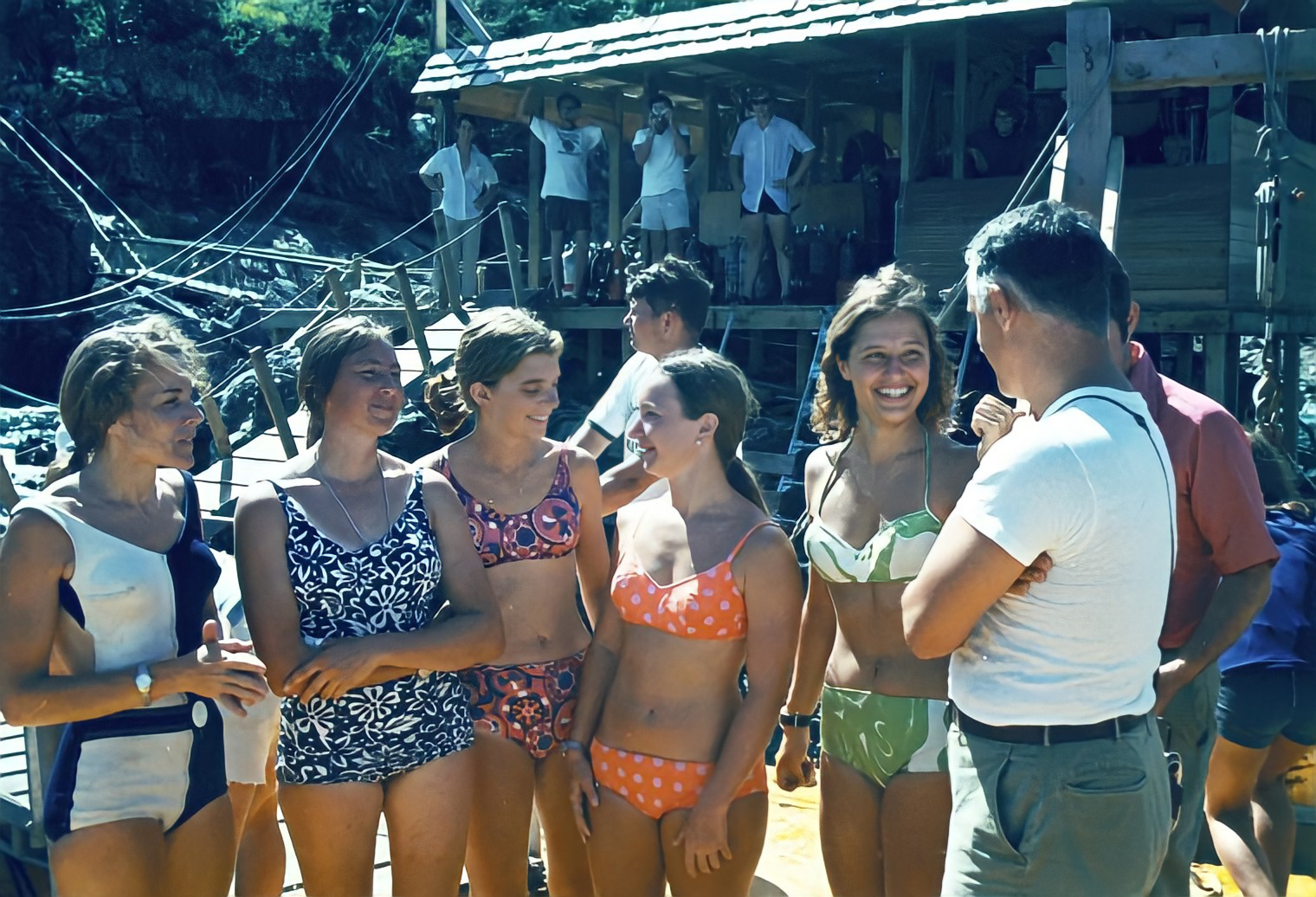
We became quite a curiosity. I can see why. There should not really have been a selection on that basis. I wasn’t really with the team that I intended to be with, but it turned out to be just fine. I had not met any of the others before we started the project, but we soon became good friends. We met on our way to the Virgin Islands where the project took place. Became acquainted on the airplane, and then for two weeks of training and learning to use the special equipment, especially re-breathers. These are devices that provide more time than scuba tanks, and they do not create bubbles. It’s a system that is much like what astronauts use on the moon in that air is recycled. Carbon dioxide that you generate as you breathe out is absorbed chemically, and oxygen is added automatically as it is consumed. It’s a nice little package that fits neatly on your back, instead of being limited to a single hour at 50 feet as is traditional with a scuba tank. With the most refined device, of the sort we were using, you could get as much as twelve hours time. Typically, we only used them for half that time or less. During the two weeks that followed, when we were living together in the Tektite and conducting our research, we got along very well, became very good friends. I still stay in contact with two of the individuals. I have lost track of the other two. I know where they are and what they are doing, but I’m sure that if we got together, we would pick up where we left off and enjoy telling sea stories all over again.
With Tektite II, you lived in an underwater laboratory for two weeks. Could you describe that environment?
Sylvia Earle: It’s described by some as the Tektite Hilton. It’s a beautiful four-room underwater motel, hotel, laboratory. The outside appearance resembled some kind of large kitchen appliance. It was white, two columns side by side, with cords running off to one side that supplied the power, the water, and the air that kept the underwater laboratory functional. The system was constructed by General Electric and we teased them saying that it looks like a big kitchen appliance.
Inside it was very comfortable. In fact, NASA engineers had looked at human factors, looking at living underwater as a counterpart for living in space. So efforts were made to really focus on what would make a pleasant living surrounding. We had some nice touches, such as different colors in different rooms, carpets on the floor. There was a television set, although nobody bothered much to watch it, because outside it was the greatest show on earth, literally, with a constant changing scene of fish and other creatures that would come by. We were outside as much as we were in. In the course of 24 hours a day, we might be ten or 12 hours out in the water. There was a nice hot shower. There was a freezer filled with frozen foods, and a complete kitchen with range and all the niceties of a nice efficiency apartment. And books for everybody. Plus a laboratory setup so that we could bring things inside and look through the microscope. We had room for a few books, and so on. It was a very comfortable place to be.
But the most comfortable, the most appealing place to be was out on the reef. The project that I chose to work with was such that I couldn’t get enough time outside. I really slept as little as I could get by with so that I could be out there with the fish, day and night. If I could, I would have been outside 24 hours a day. Couldn’t quite arrange to do that, because we human beings do have to eat and sleep, alas. Not that I don’t enjoy eating and sleeping, I do. But when there is so much going on, the astronauts surely have the same problem. You have to go to sleep when this incredible scene is out there. And yes, they do have to go to sleep so that they can be alert for the times that they are out trying to do that work. So, we did sleep from time to time in the Tektite habitat.
But we were just one of ten teams in all. The others were all male teams. We constituted the only all women’s team. The previous team left some nice little mementos around, such as a little sign over one of the portholes that said “In case of fire, break glass.” This, 50 feet underwater, of course. And then on the shower curtain… Because NASA was interested in the behavior of the aquanauts as an analog for what might happen to astronauts in space, so 24 hours a day, they had cameras inside, looking at what we were doing. It was all right with the men’s team, but what about men watching the women in the shower? Well, they put a shower curtain up there, but so as not to discourage the poor watchers, they put a pin-up on the outside of the shower curtain. Nice little mementos such as that greeted our arrival.
The best part of the whole experience though was having access to this beautiful clear water that surrounded the reef. This was in the area around St. John, in the U.S. Virgin Islands. About 600 feet off shore, 50 feet down. We had the ability to range out as much as a quarter of a mile away, using either scuba tanks or the rebreather systems. We were able to navigate using compass, we also used a system by simply putting a piece of line along the reef. We could follow it like a highway. That made it possible for us, even at night, to see where we were going, to go out to a station and then find our way safely back.
I take it that this project, just the aspect of living underwater for two weeks, really energized you and had a significant impact.
Sylvia Earle: I soon found the opportunity to stay underwater, was more than just a quantitative advantage. We had more hours in the course of a day than you could achieve on the short scuba tank passport. Using standard scuba diving techniques, it’s possible to go to 100 feet for about 20 minutes without decompressing. Decompression is the process that allows the gasses that have entered your system while diving to gradually escape so that you can safely return to the surface. If you stay longer than 20 minutes at 100 feet, it’s necessary to take steps as you return to allow this decompression process to occur.
From the Tektite habitat, we were able to stay at 100 for an indefinite period of time, because we were at 50 feet to start with. At the end of the excursion for two weeks, we had to decompress for a long period of time. It wouldn’t have mattered had we been there for one day, 14 days, 30 days. Once our tissues became saturated at the depth that we were at, at 50 feet, the decompression time is the same. In our case, it was 21 hours of decompression. We did that in a cylinder that we entered at the end of the dive, and gradually returned to surface pressure. Obviously, there is an advantage in having essentially unlimited diving time, as long as you have energy to go out. Instead of just two or three, maybe four hours in the course of a day at shallow depths, if you space it with time to decompress and have a programmed recovery time in between dives. But, six hours, eight hours, ten hours, twelve hours essentially, as much time as you could stay awake you could be in the water. But it’s more than that. There is a qualitative difference in living underwater, and the insight that you can get because we start to have the perspective of a resident. You are there day and night. You see the sun come up. You see the sun go down. You see the whole interacting suite of creatures that come in and out in the course of a day. You don’t get that on an in and out passport. You just catch a little glimpse. By becoming a part of the action, you really do see things differently. The difference could be compared to driving through the Great Smokey Mountains National Park, and going there to live there for a couple of weeks, to camp there, and feel the temperature of the air on a regular basis. Not to just glide through and then you are gone. You can get a lot from a short glimpse, it’s better than not being there at all, but boy, there is nothing like making a commitment and staying for some prolonged period of time.
Was there a turning point in your career when the potential of what you might be able to accomplish in this field opened up to you? When, instead of just studying what others have done, you discovered new avenues that you yourself could explore?
Sylvia Earle: I came along at a time when new techniques were opening avenues for exploration in the sea. The use of scuba, for example, was new when I began as a student. Every time I went out in the ocean with a scuba tank, I saw things that weren’t in books. I can still do it. It’s still that unexplored. The oceans are still virtually unknown. At first, scuba diving was considered to be a sport so fun that a scientist couldn’t possibly be using it to any serious advantage. I found that using scuba was like using a microscope. It enabled me to see things better that I could catch a glimpse of from the surface. It was such a difference to actually be there and get to know creatures interacting. It made it possible for me to really use the ocean as a laboratory.
My colleagues, by and large, who studied the ocean, operated from the surface, dangling nets and dredges and bottles, and pulling fragments up and looking at the bits and pieces, glommed together in a mass on the deck. I’ve done a lot of this myself, but it forces you to be a great detective, trying to put the pieces of the puzzle back together again, and imagine what things are like below. I have a chance to actually go below, at least within the range of diving depth, and see for myself. Try to imagine doing a similar thing to anyplace that is well-known — applying these standards of oceanographic techniques, and dragging nets or dredges through a city and bring it back up and dump the contents out on the deck. We know what its like as residents of the area, but you are just relying on what oceanographers typically have available to them. Imagine the fragments of this, the chunks of that. What do oceanographers really understand about the sea, based on such techniques?
I think I gained a certain amount of confidence in having been there, seeing it for myself. I became aware that I could contribute something special: this first-hand insight. It is still going on, and it will go on for a long time. We’re rewriting the books. These books were written based on these indirect methods of gathering blindly, in fragments and chunks and bits, that are fortuitously snared without knowing what the real situation is like. We’re gaining access to the sea, first with scuba tanks, and subsequently with tricky submarines, and even underwater robots that give us a first-hand presence.
You have been so instrumental in devising more sophisticated technologies for exploration. When did you realize that what existed wasn’t enough, that you had to create new suits, new devices for getting below?
Sylvia Earle: As I have come along as a marine biologist, using such things as scuba tanks, and the Tektite habitat, and various submersibles, I’ve gained an appreciation for the dependence that we have on technology to get where we need to go underwater. We are as reliant on technology to explore the oceans as astronauts are. We are earth-bound either way. Without technology, we have a very limited perspective. With technology, responsibly used, the horizons are infinite. I constantly found myself frustrated diving. Looking at my watch: too little time. Looking at my depth gauge: can’t go beyond this depth because I’ll get into trouble. Two hundred feet seems like a long distance for a scuba diver. It is deep, deeper than most care to go. But it’s ridiculous when you think that the ocean has an average depth of something like 14,000 feet. We are still diddling around the surface up here at 200 feet. The maximum depth is seven miles, about 11,000 meters. And we are just beginning to overcome the problems.
I guess it was a sense of frustration that drove me to try to come up with some solutions to the problem. A willingness to try alternative methods. I had an opportunity to use a system called the Jim Suit in 1979. I was interested in trying it in part because at the time I was doing a review of underwater exploration for a National Geographic book called Exploring the Deep Frontier. It gave me an opportunity to look at the technology that has helped our access or advance into the sea. I was very curious to know, and so were the powers that be at the National Geographic, what’s the latest? What’s new? What’s around the corner? Two things seemed to be in that category. Underwater robotics were just getting started: the idea that you could vicariously go exploring sitting on the surface, watching a television monitor and flying the machine that would be equipped with at least a camera, and maybe tools as well. The alternative, or another approach, was through manned devices. Instead of forcing our physiology to adapt to conditions of the deep sea, to do what astronauts do, wrap yourself in a one-atmosphere containment. Don’t try to bend physiologically, just create an appropriate shell around yourself. That shell can be small like an astronaut’s suit, or it can be large like a space ship. It can be like a submarine. That’s the equivalent of a space ship.
The idea of a suit like an astronaut’s suit that I first became aware of was a suit called the Jim Suit. I really wanted to see what it was like. Could we use this technique as scientists to gain access to greater depths than were possible just scuba diving? It isn’t exactly freedom; scuba divers can fly, and stand on one finger. The Jim Suit looks like a human being but it weighs 1000 pounds. It’s not something that you are likely to just step into and jump off a dock. If you do, the question is how do you get back up the ladder? It’s necessary to play by the rules. These atmospheric diving suits resemble a walking refrigerator or the Michelin Man, or a big white bear with joints.
This Jim Suit is cumbersome, but it does provide access, and it is a step in the right direction. Other suits are now being devised that provide greater flexibility of the limbs. The idea is simply to have a case around you, that gives you one atmosphere, surface pressure, no matter what depth you are at outside. The life support is supplied, as with astronauts, or as we Tektite aquanauts used, and that is through a re-breather like device, with oxygen being added as needed, carbon dioxide scrubbed out chemically and air otherwise circulated regularly. Breathe in, breathe out, and you just forget essentially that anything special is going on. It seems very natural. The time that I used the Jim Suit, a special arrangement was worked out. Typically it is deployed by a cable, launched from the surface and a big winch is used to reel it in and reel it out, like a fish on the end of a line. But in this case, deployment in this way was not appropriate. Also, I really prefer, when possible, to not be tied to a tether.
The combination inspired the system that ultimately was devised. And that is to be deployed on the front end of a little submarine, the Star II from the University of Hawaii, that took me down like a taxi. I was a taxi cab passenger, but I was riding on the front end of the taxi instead of in the passenger seat. We went down to the bottom, 1,250 feet. A strap that kept me attached to the submarine was then released, and I walked off. I was still attached to the submarine by a communication line, but I was not attached back up to the surface by any cable. It’s the only time that this atmospheric diving suit, or any of the atmospheric diving suits have been used in this way. Typically they do have the cable going back up to the surface.
The whole idea is to improve access and avoid decompression. This system is transportable, and enables people who are not superman or superwoman, just ordinary people, to have access to almost 2000 feet. There were 18 of these so called Jim Suits built. Named not for an acronym of some sort, and not like a gymnasium. This is J-I-M Jim. They were named after the first person willing to put one on, Jim Jarratt. It seemed at the time to be at the cutting edge of modern technology but, in fact, that suit was first devised back in the 1930s. It was devised in response to another kind of frustration, someone such as I who felt we’ve really got to solve the problems and go deeper.
In this case, the reason was to go down and salvage the Lusitania, the passenger liner that was sunk in the North Atlantic. And the suit, after having proven successful with Jim Jarret — the diver going out and demonstrating it, and salvaging some things from the Lusitania — was essentially put aside and ignored for a number of years until the early 1970s when primarily because of the offshore oil and gas industry, and the need to come up with some cost-effective alternatives to traditional diving techniques, and someone thought of using this one-atmosphere diving suit approach.
That someone, largely, was Phil Newton who, through Oceaneering International, the owners of the most of the suits, helped inspire the technique. Graham Hawkes was one of the engineers who helped reconfigure it for modern application. Both Phil Newton and Graham Hawkes were along on the expedition and helped make the whole thing possible. Al Giddings filmed it from inside the Star II submersible and I had the great fun of simply enjoying the experience and using it to explore, to evaluate the potential for scientific possibilities.
I saw in the Jim Suit at 1,250 feet in midday, in Hawaii, six miles off shore, 1,250 feet down. I imagined that it would be completely dark, just black, black dark, but it wasn’t. There was enough sunlight coming down at midday in this clear ocean water that it looked like the deepest indigo, like twilight. There weren’t stars visible to me, but there were bioluminescent creatures flashing with their blue fire, some of the same creatures that I had become enchanted with in childhood reading the works of William Beebe. He looked out of the porthole of his little bathysphere and saw little fish go by with blinking lights, saw octopuses that flashed with blue fire. Instead of squirting a puff of black ink, the squids and the octopuses that he described sometimes squirted a puff of bioluminescent ink. What good does black ink do in a black environment? It’s nice to have something that flashes, that will distract a would-be predator. A puff of bioluminescent glow-in-the-dark substance is what they do. I saw a shark, but it wasn’t a big one. It was only about 18 inches long, with a luminous green eye. So many wonderful creatures!
Most interesting perhaps was a whole field of coral, but not branching coral, just single, whisker-like spirals of coral that grew from the sea floor, up over my head. Some of them were six feet tall or so. Bamboo coral. Generally a pale white structure, like a big bed spring, a big spiral, with bands of black. When I touched the living polyps, they just flashed with rings of blue luminescence. If I touched up near the top, you could see the pulses of blue, like little blue donuts of light, pulsing all the way down the spiral of the coral. If I touched it near the bottom, I could set in motion, simultaneously, pulses of light coming from the bottom and from the top. It was just extraordinary.
It was wonderful to be able to be there. If I had used a net, or a dredge, the typical oceanographic techniques, I might have captured some of that coral, but, I wouldn’t know that they flashed with that blue fire, or that the creatures around behaved as they did. I’d only get their dead remains, and that’s a poor substitute.
Some of these dives are very dangerous. You’ve taken some big risks. In the prologue to The Right Stuff, Tom Wolfe talks about the way the rest of us just shake our heads when we look at a guy who gets into a 30-story rocket, and is lifted into space. Why do something like that? How do you get up the courage to risk your life to make these technologies possible?
Sylvia Earle: I get a lot of practice. I drive on the freeways almost every day. On the highways you can control what you do, but you cannot control those people who are coming at you at high speed from the other direction. I didn’t feel that I was risking anything extraordinary making the Jim Suit dive. There were dangers involved, but they were known. I worked with good, solid professional engineers who racked their brains, trying to think of all the things that could go wrong. I think I was safer in that than I was flying home. Well, driving home anyway. Airplanes tend to be safe.
You minimize the danger, but I get the feeling you think this is a cause worth risking your life for.
Sylvia Earle: When you think about the pros and cons of doing something for the first time, you should weigh the risks and decide whether it’s a balance. Something that you think is worth the trade off. I am not a daredevil. I really did on balance think that we had gone through the procedures, and yes, sometimes problems just happen that you haven’t taken into account. But I think that everybody in the course of a day, a week, a month, casually does things that really are very dangerous, unwittingly. In this case, wittingly, we really did think about the dangers, but we planned for them. We planned for the “what-ifs”, and practiced, rehearsed. If this happens, then we’ll do that. There were back-up contingency plans. No, you cannot plan for everything that can go wrong, and yes, you do know that there are some inherent risks. But at the end of the day, what are you going to do with your life? I could walk out on the street, and a truck could come by that I didn’t plan for. I’d rather do things that I think are worth achieving. The risks are everywhere. I could inhale bacteria and find myself in the hospital. When you have a chance to do something and make a difference, and you have weighed the pros and cons and you feel, on balance, the odds are much better than even, go for it.
Though you have made these record-breaking dives by yourself, it sounds like this is a field in which teamwork is extremely important. Is that so?
Sylvia Earle: Absolutely. Team work is essential to the success of those who appear to be out there by themselves. I certainly haven’t been, it’s always been the effort of a lot of people. And all of us stand on the shoulders of those who preceded us, historically. There is this treasure house of mechanical solutions and other engineering solutions. We just pull all this stuff together and use it. It may seem as though some individual is doing something, but it’s an individual in the company of this network of others. It’s an illusion if you think you are out there all by yourself.
You rely on other people, in a very urgent way to protect you.
Sylvia Earle: In the Jim dive, as an example, the focus quite naturally was on the individual inside the Jim Suit. ‘Twas I, that is to say. But think about those on the surface who are communicating with me. Think of those in the submarine who transported me to the sea floor, who are watching and also talking with me. Those who are operating the ship, the support divers who helped attached the Jim to the submarine. The whole team of people who made that specific exercise possible. Then, on top of that, there is the history that goes back prior to the development of the ship, the development of the suit, the first test diver, Jim Jarratt, after whom the system was named. I just happened to step in and enjoy one moment out of this great history of events that interlocks to form who and what we are.
A great detour in your career was your work with humpback whales. How were you first attracted to that field of study?
Sylvia Earle: In New York I attended a talk given by Roger Payne, who is a specialist on whales, one who had spent quite a few years getting to know the southern right whales in Patagonia, South America. At that occasion I also talked and gave a presentation about diving. And after the two presentations, Roger and I sat down and began just talking about the possibilities. Why not realize the vision that Roger Payne had of using diving techniques to get to know whales on their own terms? Up until that point in time, his work, along with his wife Katy Paine and associates, had been from small boats. Getting to see them on the surface, lowering microphones, hydrophones into the sea, listening to their sounds. Recording their sounds, and trying to understand something about the nature of the songs that whales create Humpback whales in this case. He knew about the phenomenon in Hawaii where whales come, repeatedly, during the winter months, winter and spring. But there is a place where there is a wind shadow where, despite the fact that there are high waves and winds regularly elsewhere, there is a place where you could reliably go out, where the whales came, and have calm water most of the time. So we talked back and forth and finally said, “Lets stop talking and start doing. Lets dream up a project, and go see what we can do.”
What followed over the next few weeks were telephone calls, and messages back and forth, and a few more conferences, and setting up the business of writing the proposal, several proposals, to a number of individuals and institutions to try to patch together the wherewithal to make this happen. And a critical element was being able to document what we saw. And to make this more than just a scientific research project, but to communicate with a broader audience. And Al Giddings was the natural ally in this, a really fine underwater photographer and filmmaker. So in a matter of six months, we had assembled the various ingredients needed to spend literally the next year concentrating on getting to know humpback whales, mostly on their own terms, underwater. Survival Anglia Television Organization, in England, backed the film and Al Giddings and helped with… that was one component. The National Geographic came through with support for part of the research funding. The New York Zoological Society, my home institution the California Academy of Science, and the World Wildlife Fund also came through with additional support. And some individuals who had a sailing vessel allowed us to use it as our base of operations in Hawaii. So for three months, we lived on this boat and used small rubber boats for our excursions back and forth.
Our goal was to try to get to know individual whales, just as Dian Fossey got to know individual gorillas, to track them. There had been some success already on the east coast getting to know individuals by their tails. Each tail is like a fingerprint. The patterns, and the configuration of the tail itself are very distinctive. But it’s not just the tail. The whole whale is distinctive. We know they are all humpbacks, of course, but like cats and dogs and horses and people, if you look carefully, you can see the distinguishing characteristics. By photographing them, it’s possible through time to make matches, and see who is who. Just as people have done with chimpanzees and with the great apes, and with other creatures. It isn’t necessary to tag them, you get to see them and know them and recognize them, and verify it with these very distinctive photographic records. Well, this was the beginning.
In that first year, we did not have too many satisfactory opportunities to get to know the idiosyncrasies of individual whales, but we started the catalogue, and started the information gathering. After more than a decade, year after year, people now have information on individual whales. That first whale, that I saw, Daisy, has been seen now with different cows over the years. One of the questions no one knew at the time we started was, how long does a calf stay with it’s mother? How many calves does a female have in the course of her lifetime? If you only study dead whales, you get one point in time. Lots of information, but it’s stopped with that one dead body. By getting to know individual whales and following them for a lifetime, you get these interactions, you get to know the society of whales, worlds of information that are only possible by getting to meet them on their own terms.
In that same year, 1977, we went to Alaska to get to know whales on their feeding grounds. They appear to be mating and giving birth to young in the tropics, and then go to cold water where food is abundant, and they really concentrate on getting fat. They grow up in the cold water areas where krill, and small fish are abundant. That is in the northern hemisphere. In the Southern Hemisphere, the same species of whales do a similar pattern, but in reverse. They go down to the Antarctic in that case, and then come to the tropical areas for breeding and calving. In between, they travel thousands of miles. They communicate with these hauntingly beautiful sounds. The sounds that Roger and Katy Payne have made so well known through their recordings and records, have largely been recorded in the tropics. When they are in the feeding grounds, they’re a little quieter. Some people say it’s because they don’t sing with their mouths full, but that’s just a joke of course. They do make sounds, but the songs seem to be associated with courtship and other forms of behavior that inspire song in many creatures.
Tell us about the Deep Rover, and the development of that amazing device. How did you begin working on it, and what were you trying to accomplish? What did it do for biologists that hadn’t been done before?
Sylvia Earle: In 1979, when I made the dive in the Jim, I met and began talking with Graham Hawkes, a creative engineer who had something to do with reconfiguring the Jim to go deeper, and to modernize it. At that time, he was working on various new devices for ocean exploration, primarily for commercial, industrial applications. One system, called the Wasp, was another articulated diving suit that followed the Jim. It had propellers that made it fly through the water. Still looked very much like an astronaut suit, however. He also came up with a system called the Mantis. There have been almost three dozen small submersibles developed over the years. The Mantis, like the Jim and Wasp, is operated with a cable back to the surface. It enables the operator, the diver, or pilot, in a one-atmosphere configuration, to operate the manipulators from within. Instead of having arms down metal sleeves, as in the Jim Suit, the arms are kept inside, and artificial limbs, manipulators, are operated from inside.
And when I met Graham Hawkes, he was thinking about trying to perfect better means of developing manipulator systems to reproduce what we take for granted we can do with our own hands. This was a valid concept, whether inside a submarine such as the Mantis or the Wasp, or the system that ultimately came to be known as the Deep Rover. Or the new system that we are looking at here in this room, the Deep Flight, or any manned system, but also robotic devices, so that you could sit on the surface and fly a machine equipped with mechanical arms which you can operate from thousands of feet away. Or long distances if it’s up in space, radio operated, and in the water through either hardware connection, or perhaps some day through some through-water means. Acoustic connections perhaps.
The discussions that Graham and I began to have were: “Well, why aren’t there devices that make it possible to go down to the deepest part of the ocean? We are, after all, living in an age when space craft take us to the moon. We’re talking about going to Mars. We’re sending little robots beyond our own solar system. Why can’t we go seven miles? Its just ridiculous. What’s holding us back?” Well, Graham, the good engineer, responded as an engineer would, in describing all the problems that have inhibited our access to the great depths. Pressure, of course. At seven miles beneath the surface, on the bottom, the pressure amounts to something on the order of 16,000 pounds per square inch. Sitting here, in this room, we experience 14.7 pounds per square inch. And every 33 feet you go down, its 14.7 pounds per square inch more. At seven miles, all this accumulates to 16,000 pounds per square inch. So that’s one of the problems, coming up with a material that is strong enough to endure that kind of great pressure. Working in the dark, working in the cold — problems that can be solved and certainly are not insurmountable, but the whole idea of through-water communication is difficult. Radios don’t work underwater. So how do you do this? Acoustic means are possible, but the development of appropriate systems has lagged far behind what we have accomplished for communication in an atmosphere that is more familiar, in the above water circumstances, and in space. So after listening to all of this, I said, “Well okay, but there must be some solutions to these problems. What do we have to do to overcome these difficulties?” And this is how the dialogue started, and how it continued over the following year.
He was in England, so we corresponded. When the book I was doing for National Geographic was released, he came back over and participated in the sort of celebration that we had, and saw the film about the program we were both involved with. He had been thinking about what systems could be devised using known materials. Sketched on a napkin somewhere in a file there is something that looks remarkably like the system that ultimately came to be known as Deep Rover. It was a distillation of these discussions we’d had about an atmospheric diving system that ultimately can go to the deepest part of the sea. It was envisioned that Deep Rover would someday be fitted with a glass sphere for a pressure hull. Glass is one of those wonderful materials that behaves as a liquid, and under pressure, in theory, becomes increasingly strong as the molecules get closer together. There are other materials that can be used, and in fact have been used. Steel has been used for a pressure hull. In 1960 that made it possible for two men, Jacques Piccard and Don Walsh, to go to the deepest part of the sea and come back, which is the critical part of it. Round trips are really important. This was a device known as the bathyscaphe Trieste. They made one excursion that lasted for about a half an hour, but it hasn’t been done since.
It seems like such a logical thing: let’s have full access to wherever in the ocean that we want to go. Why should we stop arbitrarily at 200, because that’s the maximum that’s possible for scuba tanks? Why stop at 3000 feet, or at 5000 feet? Why not just say, how deep is the ocean? Let’s build a system that will go to the maximum and then you don’t have to worry about depth anymore. Let’s provide it with plenty of life supports so that “how long?” is not really the issue. We have that technological capability, but back in 1979, when these conversations began, no one had really addressed these issues in this way.
The first step was to build a something that would represent a tangible step in that direction. Deep Rover was the vision of a practical machine that in the first step wouldn’t be able to go all the way down, but at least we had solved some of the engineering problems, and deal with known, tried and true materials. In this case, instead of glass, another clear material, acrylic, couldn’t go to 35,000 feet, but it could go to 3,000 feet, to about a thousand meters, and have a wide safety margin — four to one safety margin on this acrylic pressure hull.
And to equip the system with these special manipulators that had occupied much of Graham Hawkes’s time and attention. To not only come up with something that would be very dexterous, to faithfully replicate the action of your own arms and hands. To be able to pick up a pencil, for example, and write your own name. That’s something that is not commonly possible in most manipulators, but it is in the ones that he devised. But to go beyond that, and try to bring back to the operator some of the sensory feedback that we take for granted. The tactile sense. The sense of touch, the sense of motion, a sense of pressure, of force.
And with a stroke of that rare thing that I regard as genius, Graham hit on the idea of using acoustics as the means of bringing sensory feedback to the operator. That is, instead of bringing a tactile sense back through the fingertips, or through the end of the manipulator, to use this as a device that will acoustically cause a response, and bring that information back through your ears.
So the effect is that when the manipulator reaches out and touches something, it sounds hard, it sounds rough, it sounds smooth. And from the time that we are children, we grow up with the knowledge that metal sounds like metal, that cardboard, when you touch it, sounds like cardboard. That wood has a wooden sound when you tap it or touch it or scrape it. A rough surface, you get the staccato-like sound. And that’s exactly what happens. It’s not exactly a microphone. Accelerometers are used, and sound is truly synthesized to sound appropriately to the operator. Force is translated it terms of — if you press hard you get a kind of growl. It sounds as if you are meeting resistance. Grrrr. And motion is translated back to the operator in terms of another quality of sound. It sounds faster. Vrooom! Like an engine starting up and going faster. Slower is rrrmmmm. So this speed on the manipulator, the force of it, and the tactile sense all come back to the operator through your ears. Now it may sound a little complicated, and it may sound confusing. But the human brain is just marvelous in being able to listen and sort out an overlying pattern of sounds. You can listen to an orchestra, but hear the flutes and the violins and the horns, and other things. And hear a bell at the same time, or someone can be speaking, a singer, plus all the accompanying things. These are only three qualities of sounds, and you don’t have to use them all at once if you don’t want to.
I have gone on at some length about this, only because it is so important as a means of setting the capability of this machine apart from what has gone before. It has been possible, even 60 years before in Beebe’s Bathysphere, to go out and look through and see things. But Beebe experienced the same frustration that I did when I used submarines that did not have manipulators. You sort of scratch on the glass like a child in a candy store with no nickel. You can look but you can’t touch, you can’t taste, you can’t get beyond the glass. And it is enormously frustrating. So having a system that will go where your own arms cannot go is tremendously important. And the better they are, the better will be the quality of work that you can accomplish.
Cameras are the same way. You can get cameras that can faithfully replicate — and even sometimes go beyond — what your own eyes can pick up. Low light level cameras, for example. Night vision cameras that can enhance the small amount of light that might be available. These are the kinds of instruments that have been added to submersibles such as Deep Rover. Deep Rover didn’t exactly just happen.
It’s one thing to make a sketch of Deep Rover and scheme about how it’s going to be. It’s another to raise the money to actually build one. Graham Hawkes and I tried to find supporters to share this vision and build two Deep Rovers, because the idea of buddy diving submarines, like buddy diving divers, makes a lot of sense. Although Deep Rover, as Graham Hawkes envisioned it, would be a clear sphere with two manipulators in the front to operate as extensions of the pilot’s arms. And the battery packs below, life support behind and so on. Lights in the front, cameras, et cetera. All the manipulators. It looks like a little submarine, but in fact it is a diving suit. It is an extension of the operator. Funding was a challenge. We weren’t able to get what we wanted soon enough. Starting in 1981, we finally gave up on the idea of philanthropic support, and decided to do what Graham had successfully done before, and start a business. We hadn’t been able to identify a market for Deep Rover but we were able to identify a market for robotic devices. So we began Deep Ocean Technology, and Deep Ocean Engineering, For the next three years, we mostly did just that; building large robots equipped with the same kind of manipulators that ultimately would be used on Deep Rover.
Finally, through a collaboration with our ally Phil Newton, and the company Can-Dive, and working with funds provided with the Canadian Government, Deep Rover was launched in 1984. This occurred in Halifax, Nova Scotia. Later the system was moved to Vancouver, but it was not until 1985 that it was first used for a scientific project off the Monterey Canyon. Dr. Bruce Robison, a distinguished zoologist and a friend of many years, who also believed in the concept of Deep Rover, sponsored a project with funding from the National Science Foundation, using Deep Rover for a series of exploratory dives. These have become a classic in terms of what has been learned about the Monterey Canyon.
Soon after that, with sponsorship that we gathered from several sources, we were able to get together a series of dives for Deep Rover near San Diego. These were the record-making excursions to 1000 meters, a little more than 3000 feet. Graham went first, as the designer of the system, which is only right. I had the fun of being the second person to try it on, and also go down to the same depth. The third was Phil Newton, who had joined with us, with sponsorship by the Canadian government to develop and to finally launch the first Deep Rover. The final person who later was able to take Deep Rover down to this 3000-foot area was Bruce Robison, the zoologist. He is now at the Monterey Bay Aquarium Research Institute.
We worked together on a project in the Bahamas. I had the fun again of using Deep Rover for exploratory dives. It is extraordinary to be able to step into this clear sphere, sitting in an armchair like this, and just imagine. If you want to go forward, you simply slide your arms forward a little bit. And microswitches under the arm rests kick in, engaging the thrusters, and forward you go. You want to go in reverse, you slide your arms back a little bit. If you want to dive, press down with your wrists, the vertical thrusters are engaged, and down you go. If you want to come up, you press down with your elbows and lift your wrists, and you come up. If you want to really come back up to the surface, not just modify the position a little bit, there is a lever over your head which modifies the ballast. Either you displace ballast, and become lighter and return to the surface, or by allowing water ballast to be taken into the tanks, you become heavier and you sink. By fine-tuning the ballasts over your head with this handle, it’s possible to become perfectly neutral, and be like a jelly fish, and just be there as a piece of the water column, to be one with the creatures who are there. That’s what Bruce Robison and his colleagues did in Monterey. It’s what I did in my several dives in San Diego and then later in the Bahamas. To be able to go down, along those beautiful drop-offs, and to see the change in life as light diminishes, finally into blackness. And to see the bituminous creatures again like fireworks burst and illuminating the water column around you as you either descend or more forward. It’s a marvelous experience. It’s a thrill at every turn. It’s an opportunity for discovery of the sort that we must have if we are to understand how the ocean really works.
Your collaboration with Graham Hawkes has been like a marriage of science and technology, don’t you think?
Sylvia Earle: It’s marvelous for scientists to work with engineers such as Graham Hawkes. You can set goals like, “I’d like to fly with the tuna fish. I’d like to hover mid-water with these lovely diaphanous jelly critters. I would love to reach out and pick up something without crushing it.” Engineers can come up with a lot of these things on their own, but it is very useful for them to know what scientists’ goals are. It’s the logical thing to do. It should have been done much more than it has been historically, and I’m sure it will be in the future.
You are sitting in front of your next great project. How will Deep Flight help scientists in the future?
Sylvia Earle: Almost before Deep Rover got into the water, Graham was designing the next step. Part of this came from discussions with scientists such as Bruce Robison. What can’t you do that you need to do? Deep Flight is a system that can move swiftly through the water. Graham Hawkes really likes the idea of coming up with something that can behave like an aircraft underwater, that can do loop-the-loops that can do the equivalent of aerobatics – how about hydrobatics? To have the sheer joy of the freedom that aircraft give to those who fly them- – to have the equivalent in the sea. Most submersibles are more like the equivalent of balloons. They move with ballast systems. Even Deep Rover goes down heavy and comes up light. Deep Flight is constantly light, it is positively buoyant. So that If you take your hands off of the controls and do nothing, it will gradually come back up to the surface. In order to move, it has to be powered along, like an airplane. If you take your hands off an aircraft, it doesn’t go up, it goes down. In order to stay aloft, you have to keep the power moving. With Deep Flight, many of the parallels with aircraft are obvious. It’s streamlined, it has little wings. It will be able to do some maneuvers in relative slow motion, but remember, this is a thick medium compared to the atmosphere. This is the aquatic atmosphere, but some of the same engineering principals apply. So there is a very nice correspondence between aeronautics and hydronautics, aerobatics, and the new art of hydrobatics.
It doesn’t weight very much compared to most submarines, so it can be transported, and perhaps even deployed from a helicopter. And recovered from a helicopter. It can go virtually anyplace in the world. We hope to go to the edge of the ice in the Antarctic, where no submarine has yet been for scientific research. We have had some underwater robots to the Antarctic, but no manned submarine. We may be the first to follow the little whales and see what they are doing. Instead of watching their tails disappear into the distance, we’ll be able to go where they go, to see what a sperm whale feeds on. Maybe we will see that ultimate invertebrate, a giant squid. They might be 50, maybe 70 feet long. No one has ever seen one alive, only fragments and bits.
You have done a lot of speaking on behalf of ecological and environmental concerns. Why have you given so much of your precious time as a scientist to those causes?
Sylvia Earle: Years ago I became aware that the planet was changing. It’s hard not to be aware of that, but having grown up in a time when the changes have been coming so fast, places I knew as a child are simply gone. They are leveled, they are covered with cement. The farm my father grew up on is no more. The farm that my mother knew as a child is simply gone. The sea coast everywhere has changed. It used to be possible to go out and dig clams, and feel happy about eating them. You knew that they were good for you, they were healthy. Now, people are very wary of eating any shell fish, oysters or clams or mussels, because of the pollution that may be really adverse to our health, never mind the health of the mollusks themselves.
That concern has caused me to become forthright about environmental issues. It’s difficult to be complacent, difficult to focus on the fine points of scientific research that I have historically done. I haven’t, by any means, stopped that. I still spend many happy hours hunched over a microscope and looking through the books, and doing the kind of detailed analysis that is the fundamental backbone of who and what I am. It provides the material necessary to come up with answers in an environmental sense. We must make decisions based on the best knowledge available.
It’s possible now, to rely on this great body of information already amassed, with new studies that will give information that we need, about what to do. How do we maintain the good health of the planet? How do the systems work? What are we doing to damage these systems? The ozone layer is one example. It’s one thing to document and record the fact that the ozone hole has been developing over the Antarctic area. It’s another to know how to fix it. It’s one thing to document increasing pollution in this city, but what do we do? How do we make it right? One of the things that increasingly has become clear is that we are losing the standards, losing the models, losing the basis for good health of the planet. That is the wilderness, on land and in the sea. Wilderness is not just valuable because it’s beautiful, or aesthetically appealing, it is the stabilizing part of the planet that creates the good health that we have always taken for granted. Most of the sea is still in this healthy, wilderness state. But at an alarming rate, we are changing the oceans. We certainly can see the evidence that we have changed the terrestrial part of the planet. But it isn’t just terrestrial/ocean, as if these are two separate things. They are all part of the interacting ecosystem of the earth.
Just recently I have accepted the role of chief scientist of NOAA. That’s the National Oceanic and Atmospheric Administration. I’m taking a leave of absence from Deep Ocean Engineering, where I have been the President and the CEO for the past several years. Of course, I am continuing to work with Graham, with Deep Flight, with Deep Ocean Engineering, and the new systems that will be cutting edge of exploration. We have a project we are calling Ocean Everest. It is the ultimate extension of being able to gain access to the sea. Whether it’s a system that looks like Deep Rover, or long and slim like Deep Flight, or some as yet unimagined engineering design for access to the greatest depths, that vision remains. With the volunteers who are currently developing with Graham Hawkes and the others who are associated with Deep Ocean Engineering, and with Deep Flight, the next step will be Ocean Everest.
From my perspective as chief scientist at NOAA, I can provide the ongoing rationale for why we need to do these things. It is fundamentally essential that we have access throughout full ocean depth from the surface to the sea floor. Mostly what I will be doing in the near future, however, will be focused on the environmental concerns that you asked about. NOAA is an agency that embraces the National Weather Service, the National Marine Fisheries Service, the National Ocean Service, which is the aeronautic charts and the charts for navigation in the sky as well as in the sea, plus a great deal of the assessment of the marine environment. Mostly in U.S. waters, but in a global sense as well. It includes a satellite program for environmental assessment — the weather satellites and so on. As well as the ocean and atmospheric research. These five offices that are encompassed in that. As chief scientist, I have an overview responsibility. It’s a tremendous opportunity for me to learn more, and to encourage the use of whatever equipment, whatever tools, whatever knowledge we have to take care of the planet. We certainly are at a time that is increasingly obviously necessary.
Thank you so much for speaking with us today. It was wonderful.