

I like pressure. That's what makes me. If you're going to be a jock, if you're going to be a champion, what are you going to? You’re going to have pressure every day.
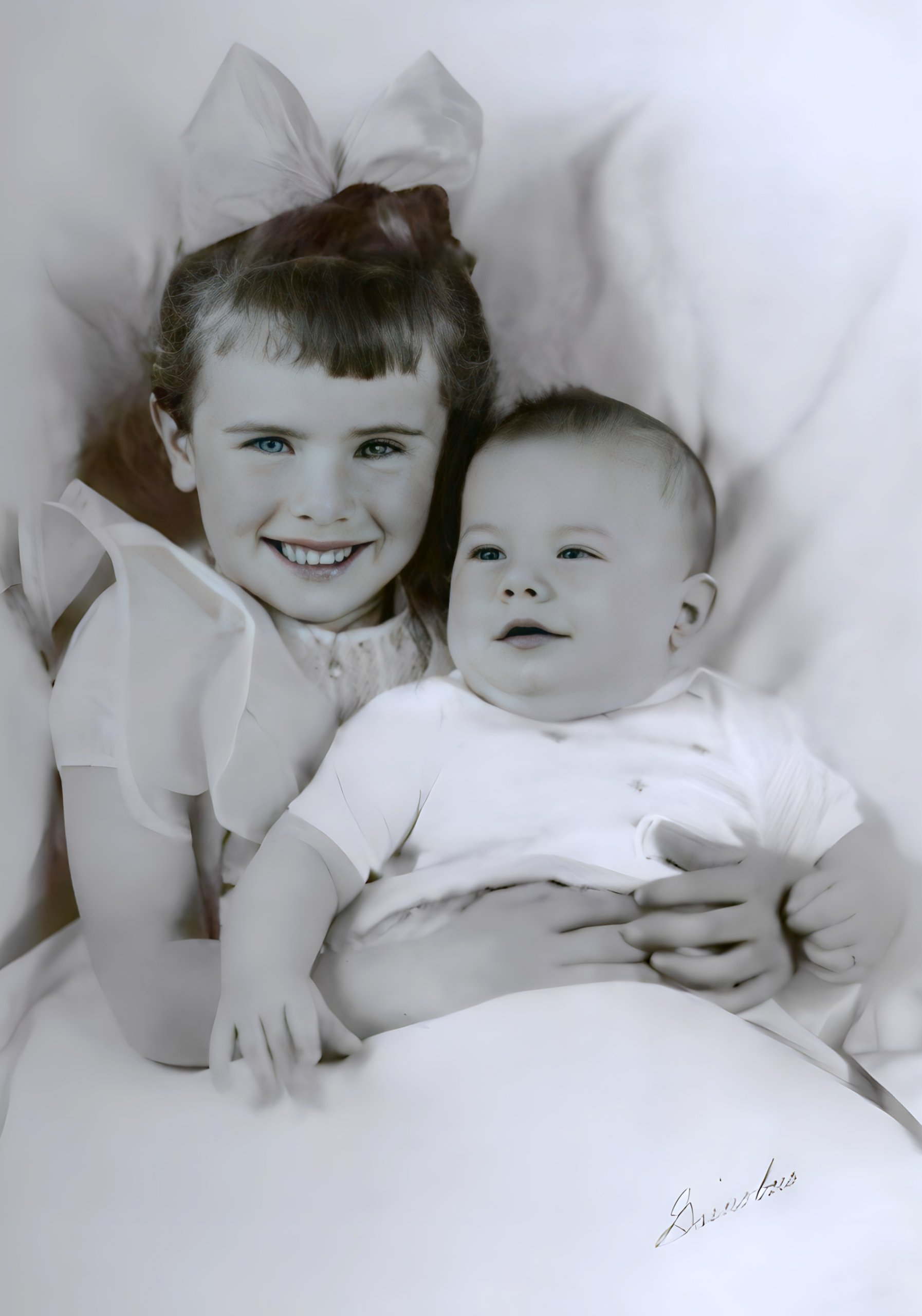
Billie Jean King knew she had a place in tennis: at the top. Born Billie Jean Moffitt on November 22, 1943, in Long Beach, California, she grew up in an athletic family. During World War II, her father, an exceptional basketball and baseball player, led physical training in Norfolk, Virginia, for servicemen heading overseas. Her mother was an accomplished swimmer. Her brother, Randy Moffitt, became a professional baseball player. Still, Billie Jean’s greatness in tennis was hard to predict, especially because her father’s firefighter salary meant she didn’t have the money to join a country club or pay for a coach. As a young child, Billie Jean played a lot of basketball and softball. She did not start hitting tennis balls until age 11, but once she did, she was hooked. She read everything she could about tennis history and its greatest players. She found public courts and heard about a city program offering free lessons from a pro named Clyde Walker. One day when her mother picked her up after her first lesson with Walker, she was practically jumping up and down in the car with excitement as she said, “I found out what I’m going to do with my life.” When her mother reminded her she had homework, she pressed on: “I want to be the number one player in the world.”
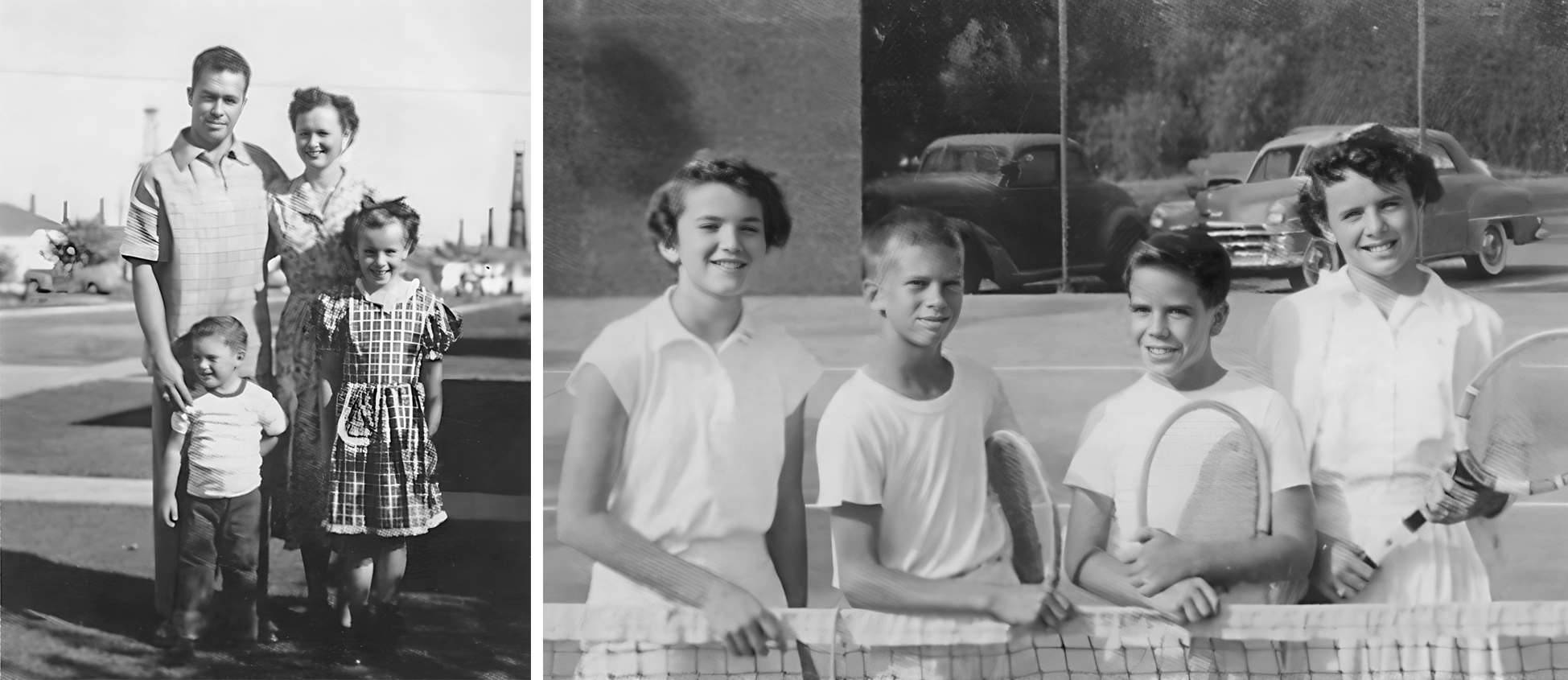
At an early tournament at the Los Angeles Tennis Club, she wore tennis shorts her mother had sewn for her. Perry T. Jones, the czar of Southern California tennis, told her female players should wear skirts or dresses and barred her from appearing in the group photograph of the junior players. Billie Jean’s mother was mortified and that night began sewing her daughter a tennis dress. Billie Jean felt it was an injustice and said it spurred her determination to change the rules around the game.
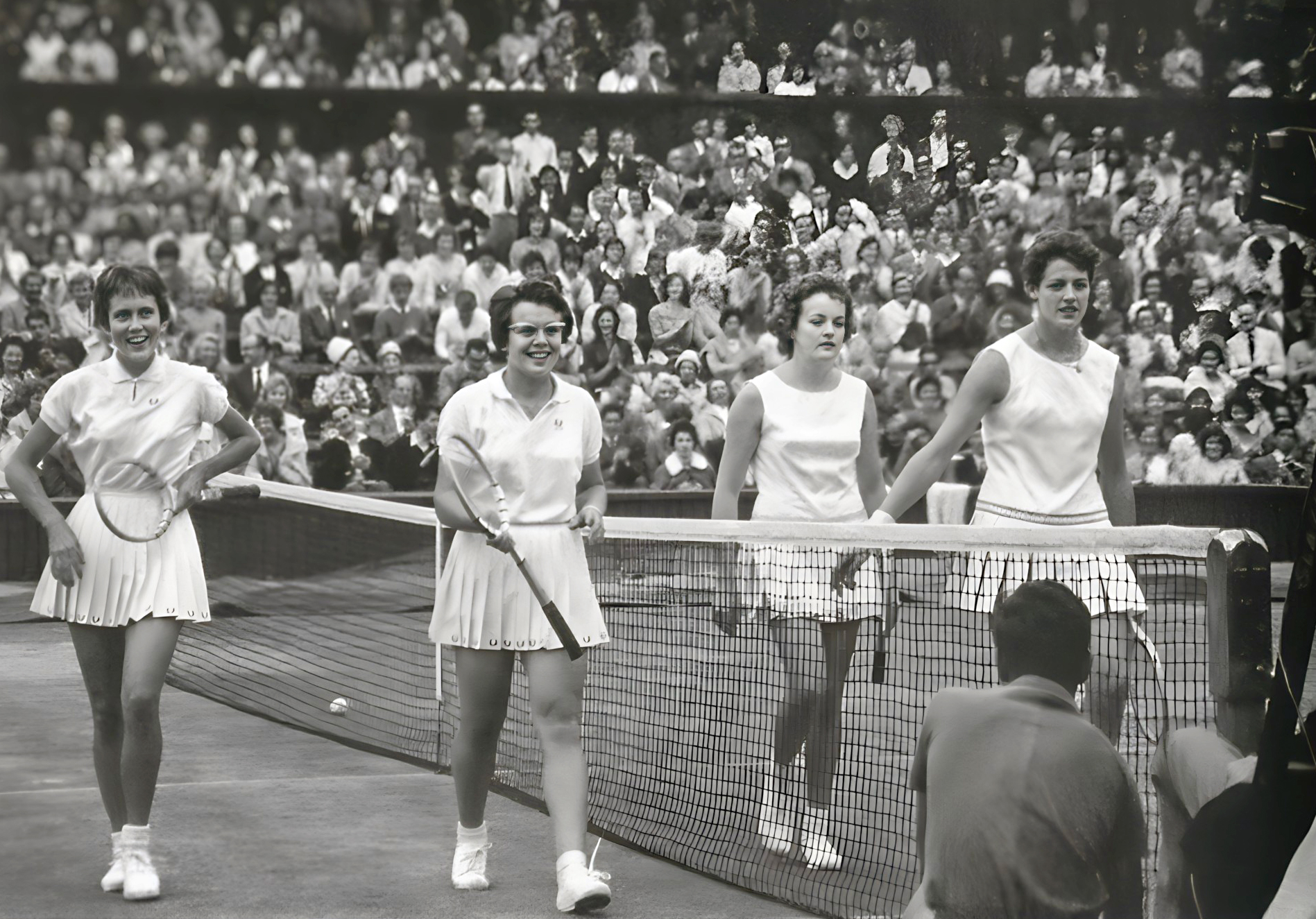
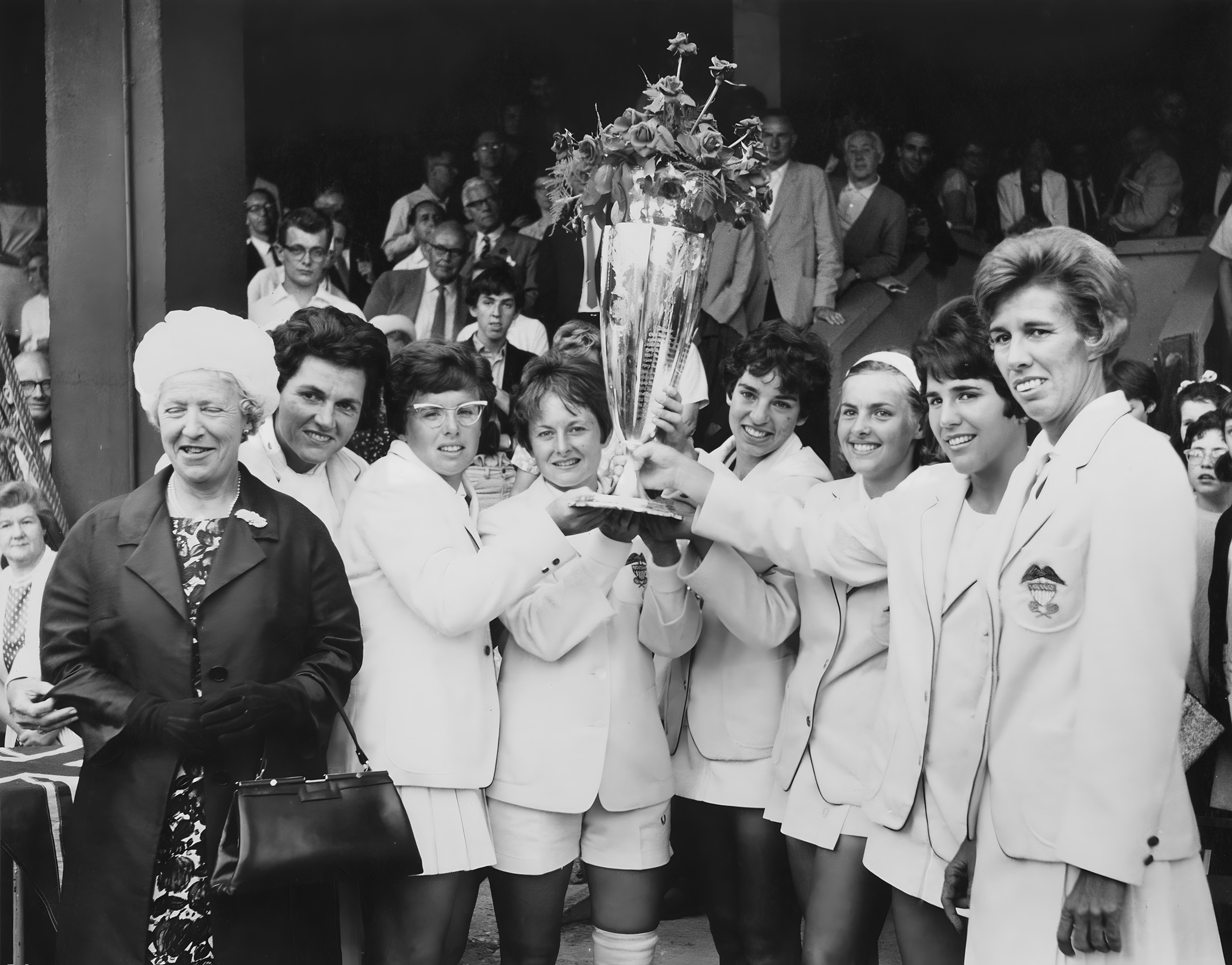
As a young teenager, Billie Jean kept playing the Southern California circuit, where she stood apart for her strategy. Most juniors won by keeping the ball in play. Billie Jean wanted to be the best in the world as an adult, so she served and volleyed and attacked the net, even when that cost her junior matches. Her focus paid off. In 1961, at age 17, she had become so good that she competed in women’s doubles at Wimbledon with another California tennis player, Karen Hantze, 18.
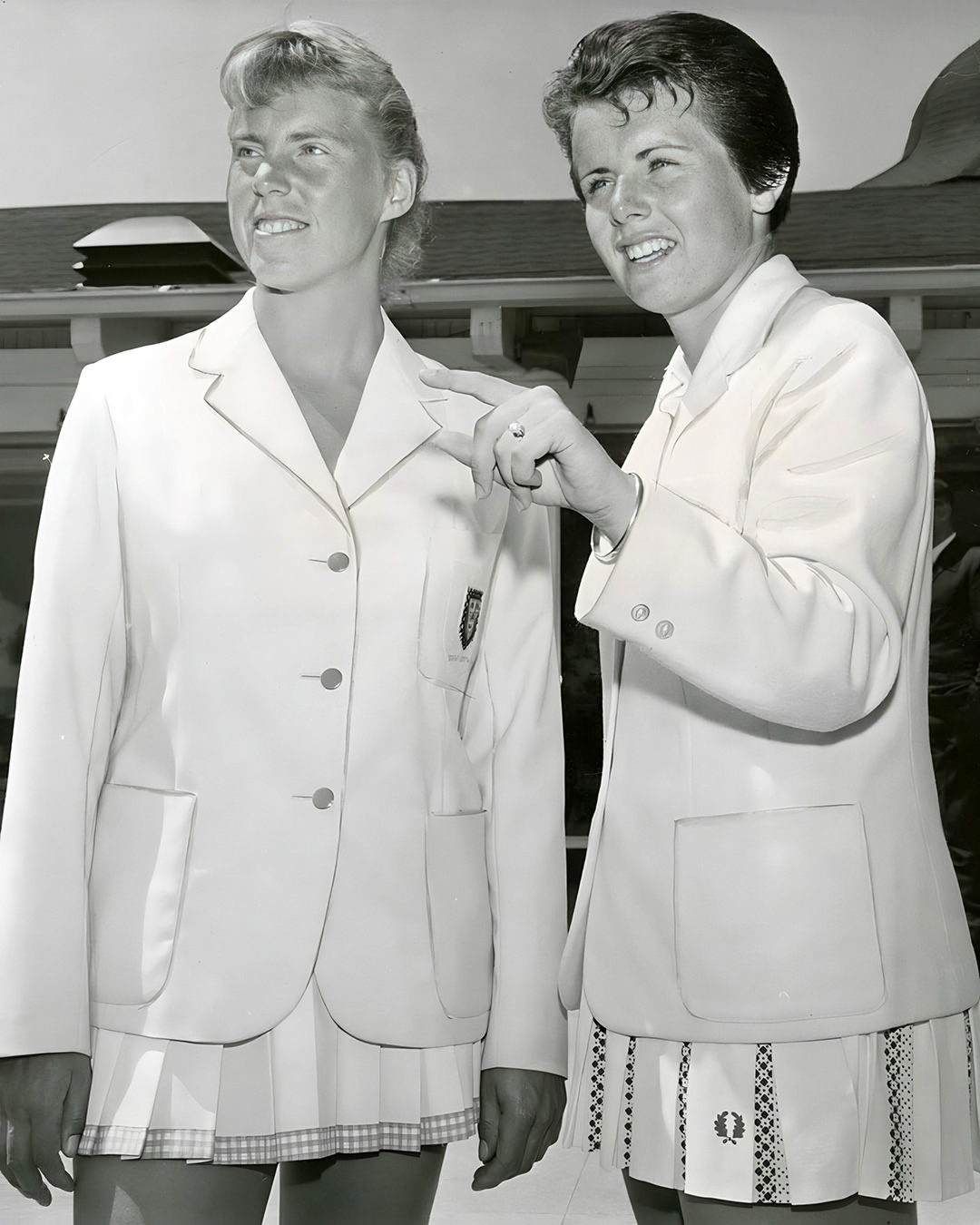
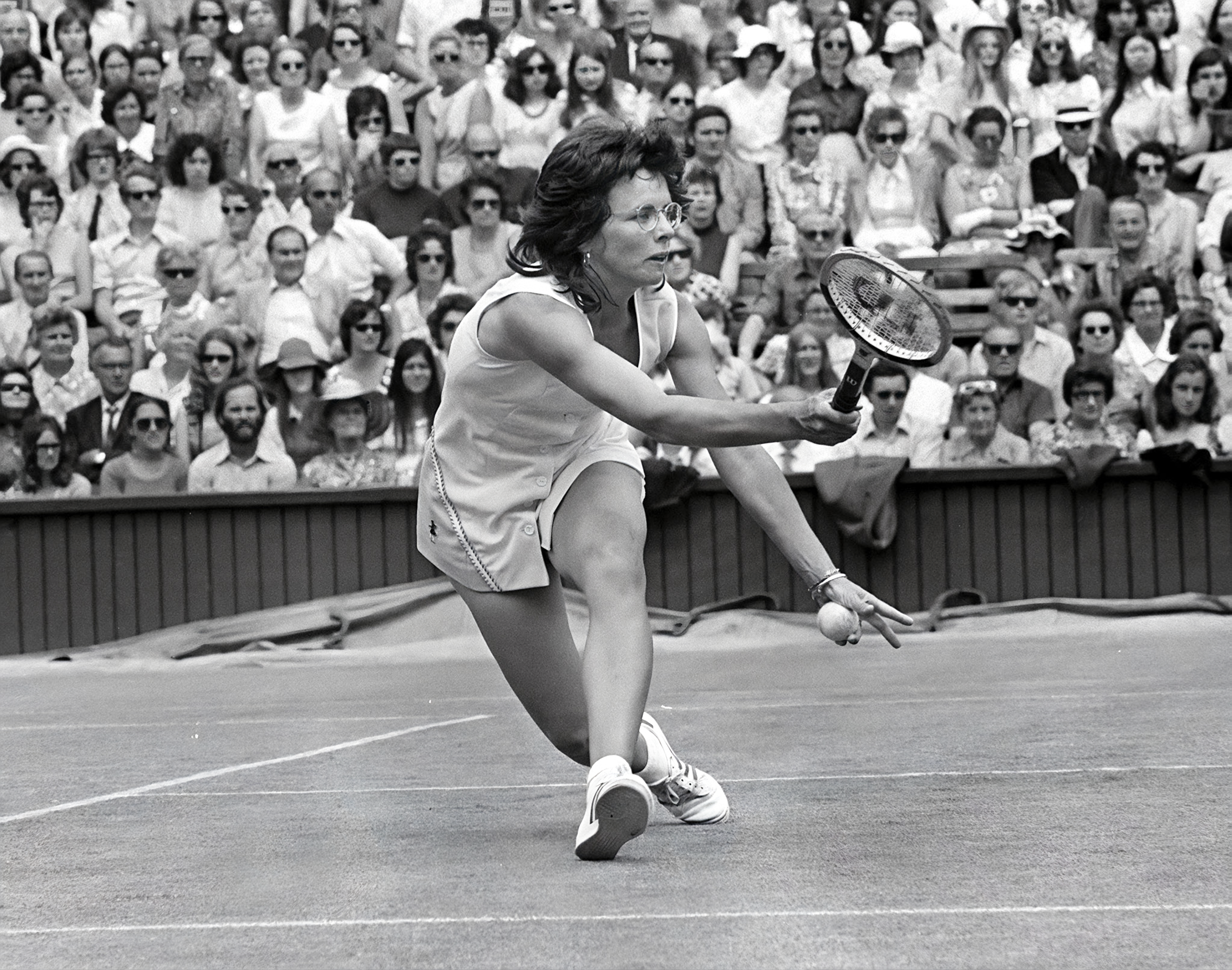
She and Hantze were unseeded and had so little money that they came home from London with $3. But they won, the youngest duo ever to win the Wimbledon women’s doubles title. It would be years before Wimbledon awarded cash prizes, but the trophy was a rocket boost to Billie Jean’s career. It was the first of her 20 Wimbledon titles, a record she now shares with Martina Navratilova.
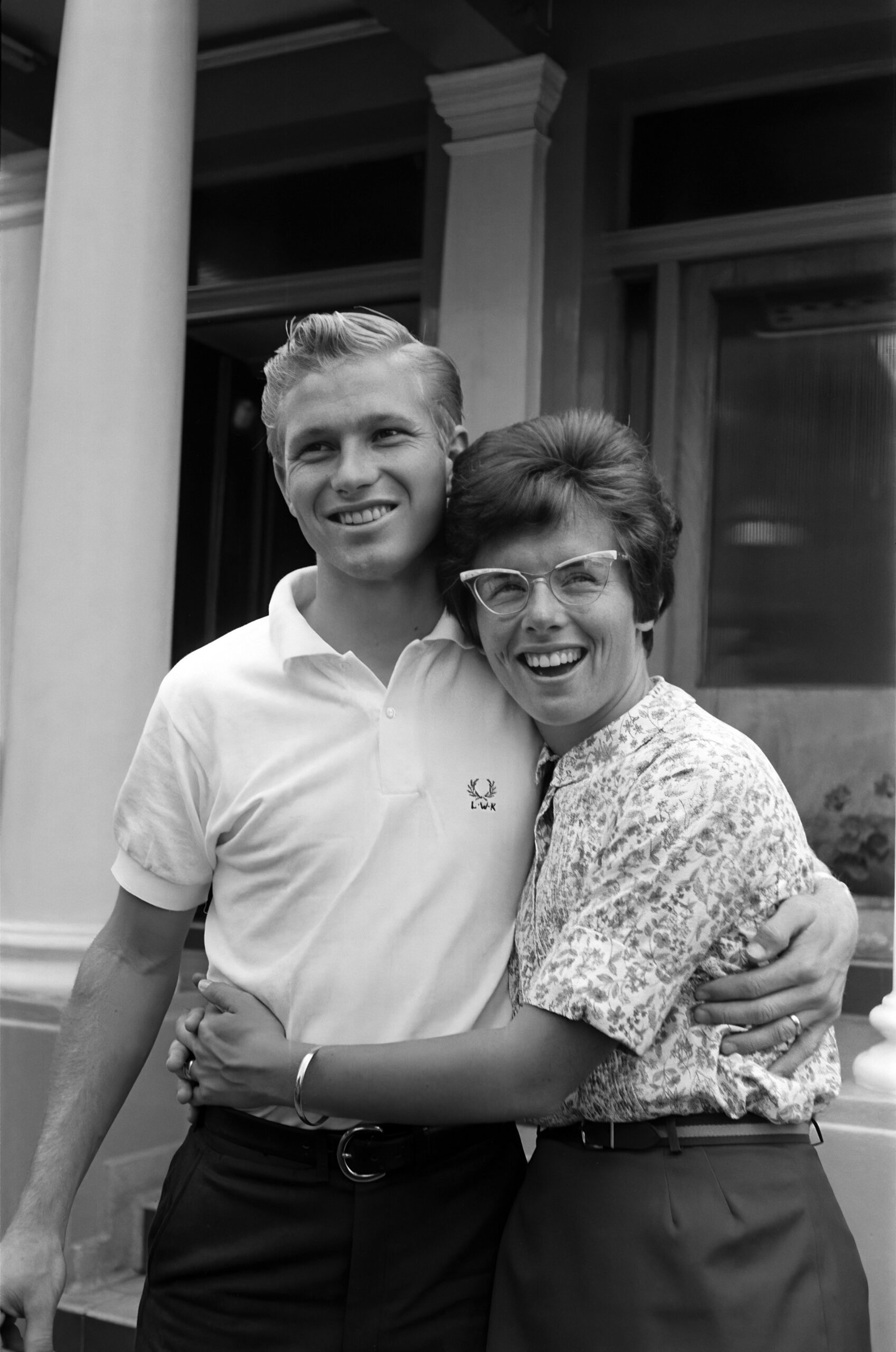
Back home, she continued playing tournaments and enrolled in California State University, Los Angeles (then called Los Angeles State College). There she met Larry King, another student who played college tennis and later became a lawyer. During the 1960s, it was common for universities to offer elite male tennis players scholarships when they offered none to female tennis stars. To pay her bills, Billie Jean worked as a playground supervisor and in the school locker room. But juggling two jobs, playing tennis, and studying was not easy, and she dropped out of college in 1964 to focus on tennis.
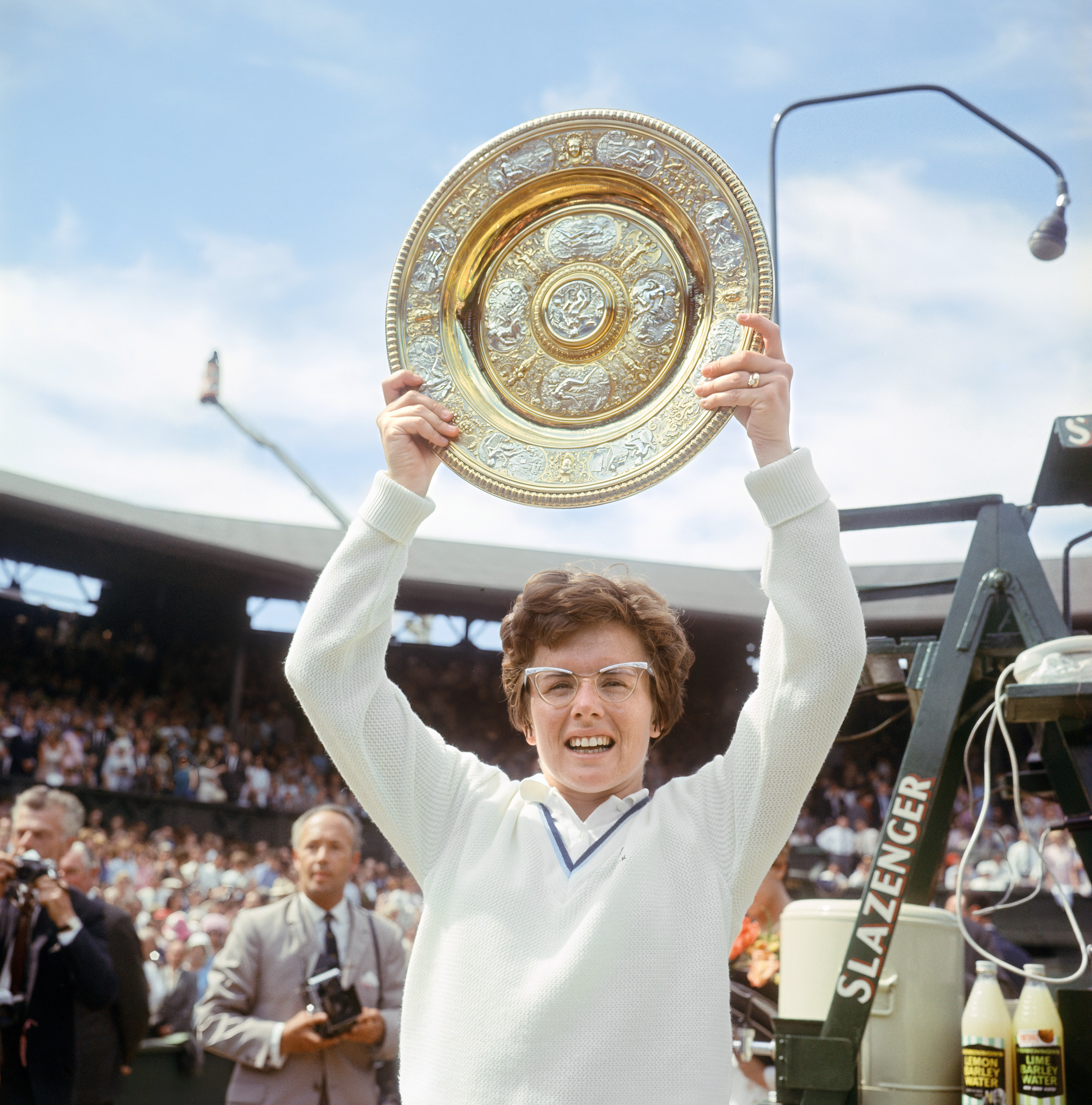
In 1966, she won her first singles title at Wimbledon. She was listed on the champions’ board as “Mrs. L.W. King,” under her husband’s initials. That year she also became the No. 1 women’s player in the world, the goal she had set for herself as an 11-year-old. She would hold the top ranking in six different years. She captured the Wimbledon singles trophy again in 1967, 1968, 1972, 1973, and 1975.
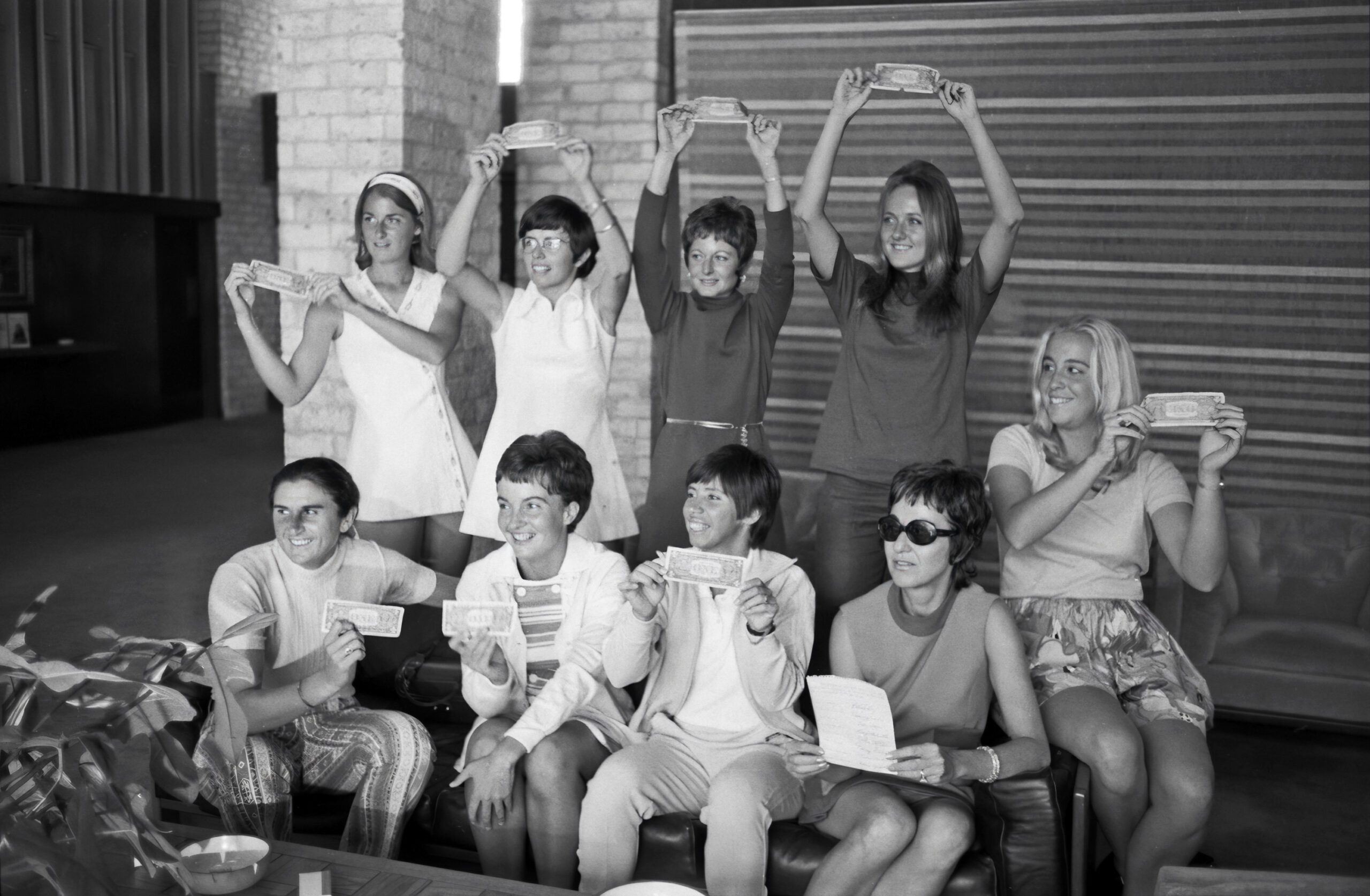
She wanted more people to follow women’s professional tennis, and she had the backing of her husband. In 1970, she became one of the Original 9, a group of elite female tennis players who signed symbolic $1 contracts with publisher Gladys Heldman to compete on a separate tour from the men and advocate for equal pay. That tour became the Virginia Slims circuit, the forerunner of today’s women’s tour. She also resolved to earn $100,000 in prize money in a single season, knowing it would be widely reported by sports journalists. When she hit that milestone in 1971, she hoped children would see that they could grow up to make a living playing professional tennis.
In 1972, Billie Jean won Wimbledon, the French Open, and the U.S. Open. With the French title, she had won all four Grand Slam singles championships (she had taken the Australian Open in 1968), a feat known as the career Grand Slam. She made headlines as the first woman to win Sports Illustrated’s annual award, sharing it with legendary basketball coach John Wooden. The magazine named them Sportswoman and Sportsman of the Year, and they appeared together on its cover. Still, the pay gap persisted: her 1972 U.S. Open victory earned her $10,000 while the men’s champion, Ilie Nastase, was awarded $25,000.
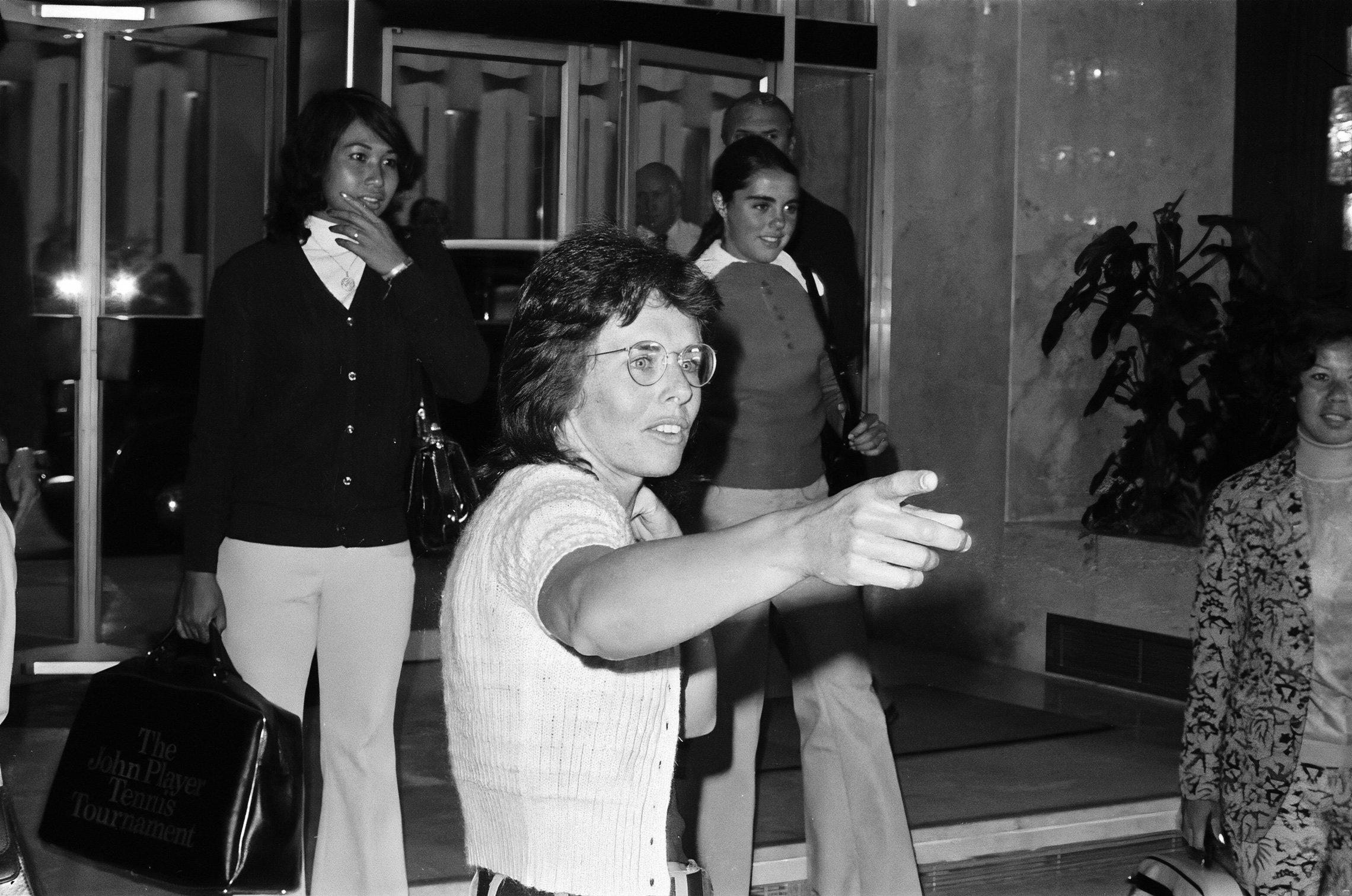
Increasingly known for her advocacy of gender equality, in June 1973, on the eve of Wimbledon, she helped form the Women’s Tennis Association and became its first president. Two weeks later, she won the singles, doubles, and mixed doubles titles there. That same year, after she threatened a boycott by the women players, the U.S. Open became the first Grand Slam tournament to offer equal prize money to male and female competitors.
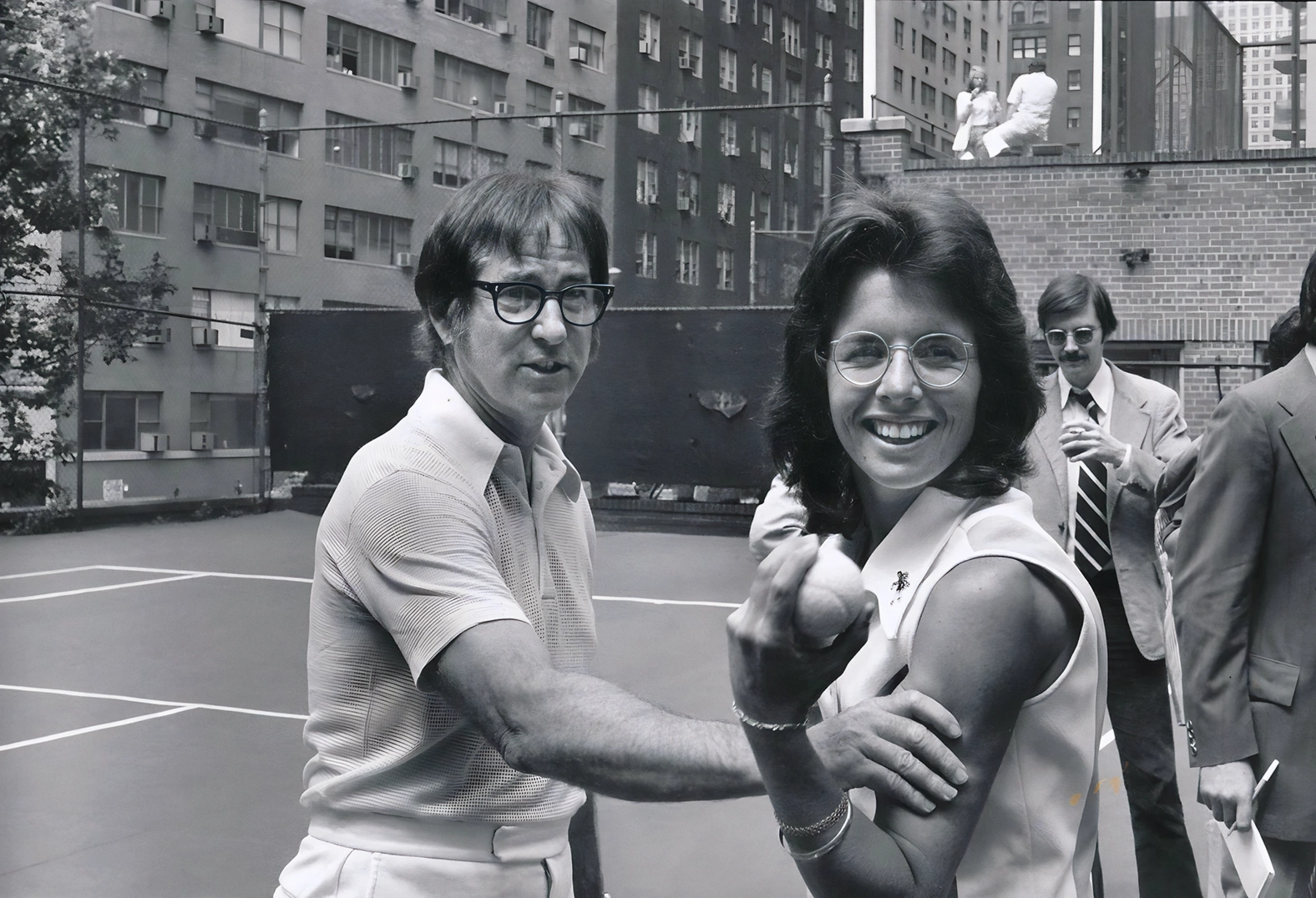
Then along came Bobby Riggs, a 55-year-old former Wimbledon champion and self-described hustler and male chauvinist. He loudly declared that women’s tennis was inferior and challenged Billie Jean to a match. When she declined, he turned to 30-year-old Margaret Court, one of the world’s top women’s players. He bragged that an aging man like him could beat the best female players. When he routed Court in May 1973, Billie Jean said she would play him.
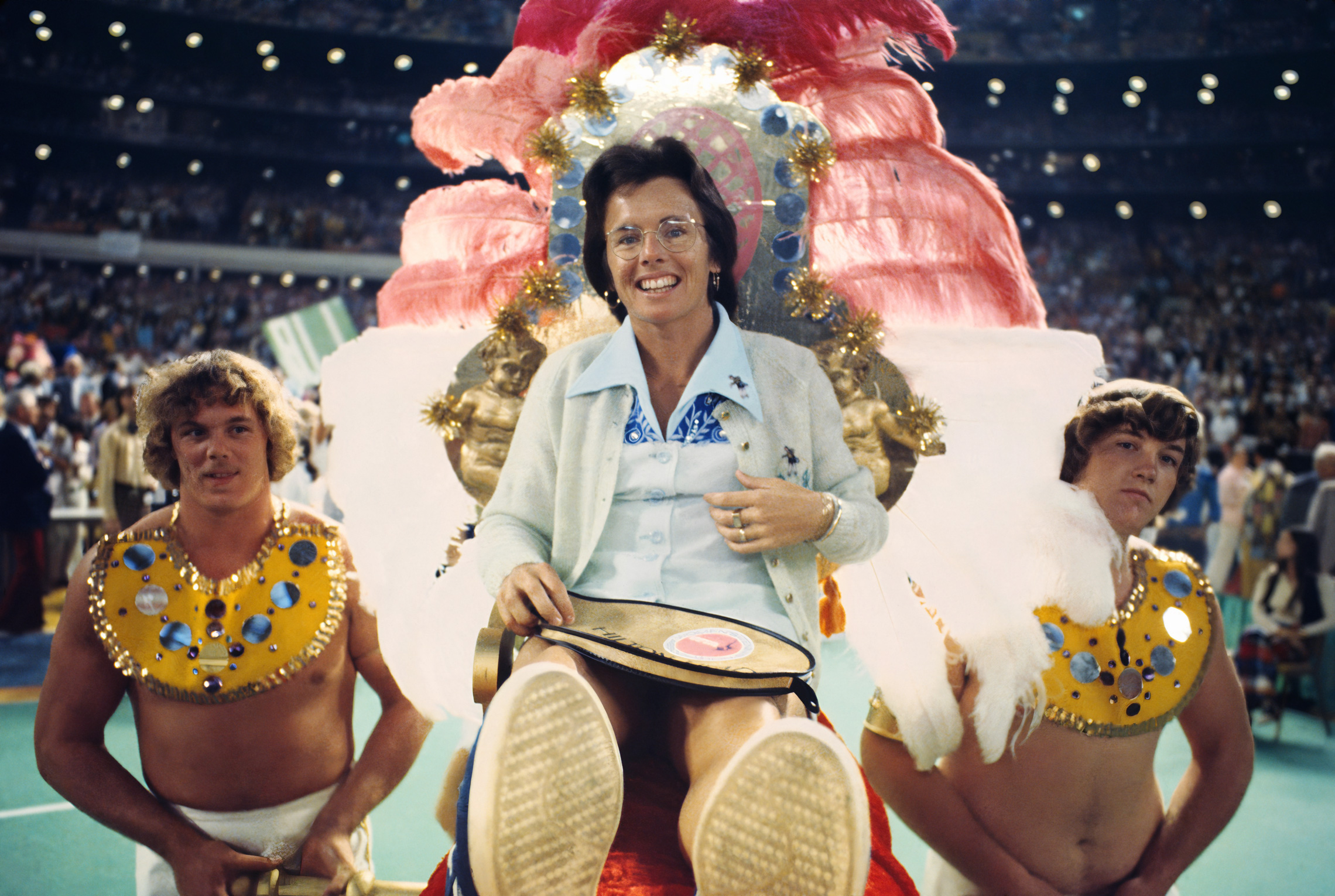
Just a few months later, on September 20, 1973, she played Riggs in the Houston Astrodome for a $100,000 winner-take-all prize. The match was wildly publicized and promoted as the “Battle of the Sexes.” More than 30,000 filled the arena, and an estimated 90 million watched it worldwide. Billie Jean, who famously says, “Pressure is a privilege,” beat Riggs in straight sets, 6-4, 6-3, 6-3.
Her win had far-reaching impact. Women in many different jobs told her afterward that the match had emboldened them to ask for raises – and that they got them. Barack Obama, who watched the match when he was 12 years old, later told Billie Jean that it guided him on how to raise his two daughters. Title IX, the federal law banning sex discrimination in education programs, including school sports, had passed the year before. The match gave it a human face, and Billie Jean became one of the law’s most visible champions.
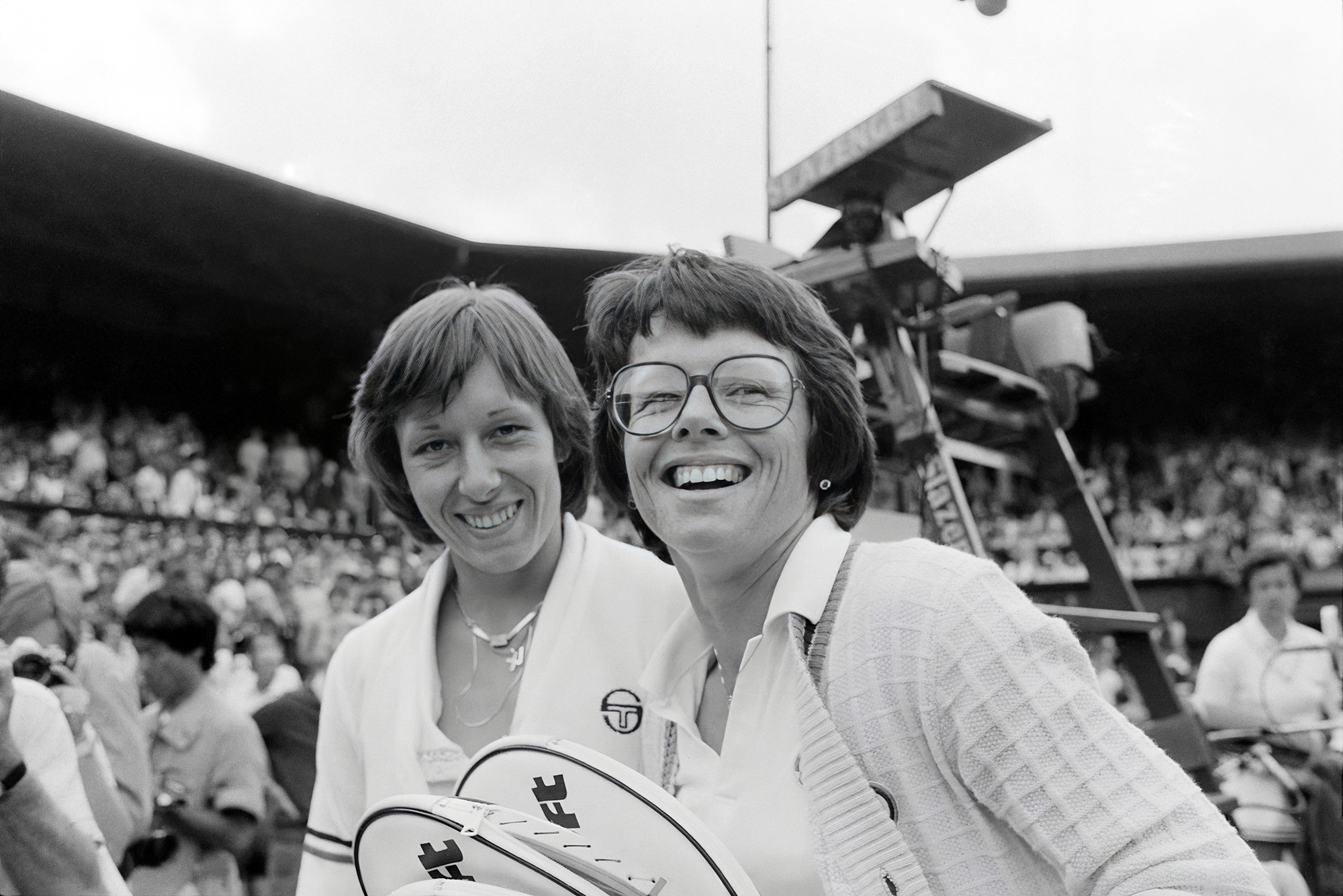
She kept breaking barriers. In 1974, she founded the Women’s Sports Foundation to expand opportunities for girls and women in sports, and she and Larry helped launch World TeamTennis, a coed professional league she would run and own for decades. She was the first female athlete to have a signature shoe with Adidas.
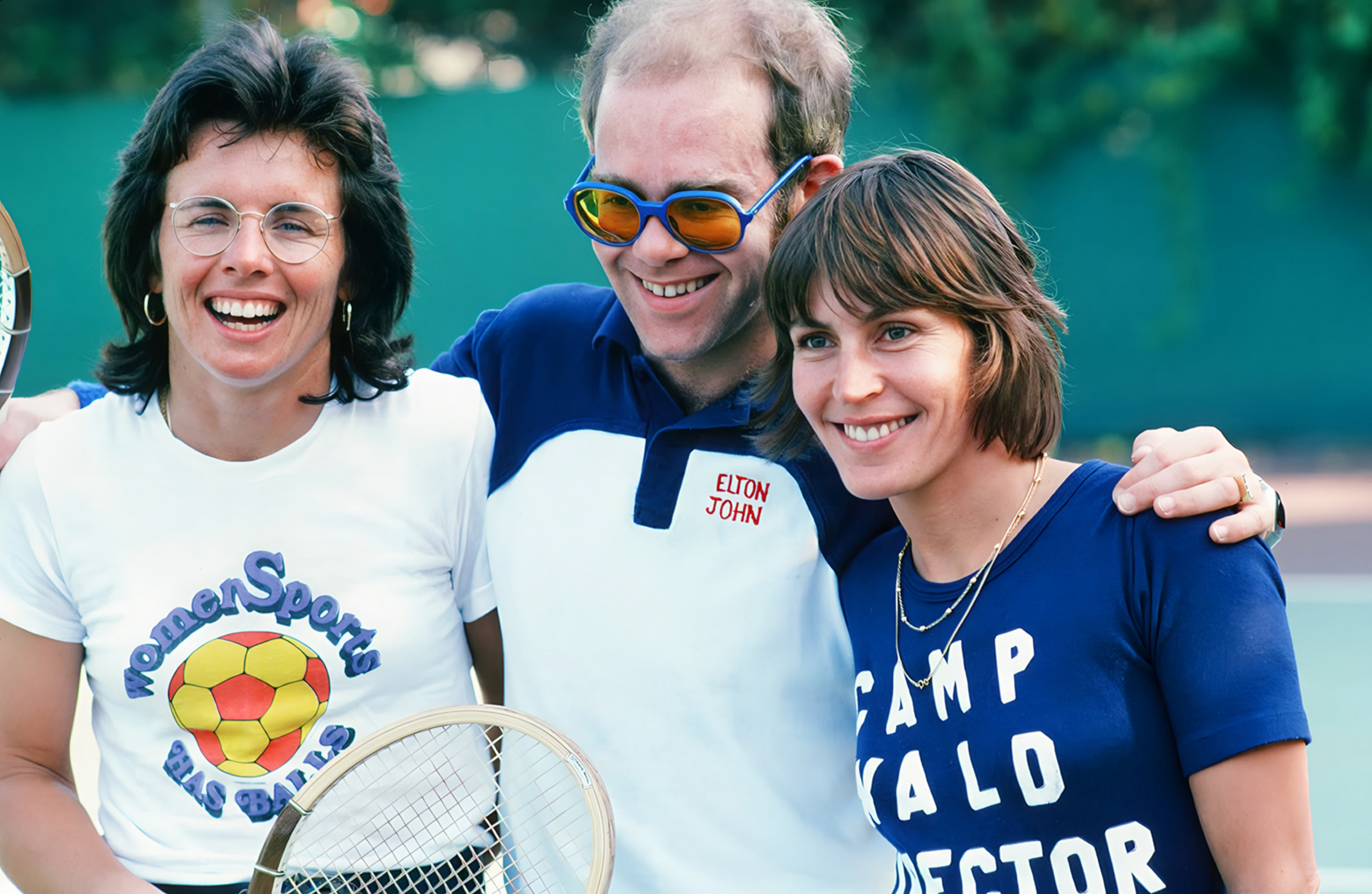
She even had a No. 1 hit song written for her. She had become friendly with Elton John, and because she played for and coached the Philadelphia Freedoms, her World TeamTennis team, he and lyricist Bernie Taupin wrote “Philadelphia Freedom” in her honor; it was released in 1975.
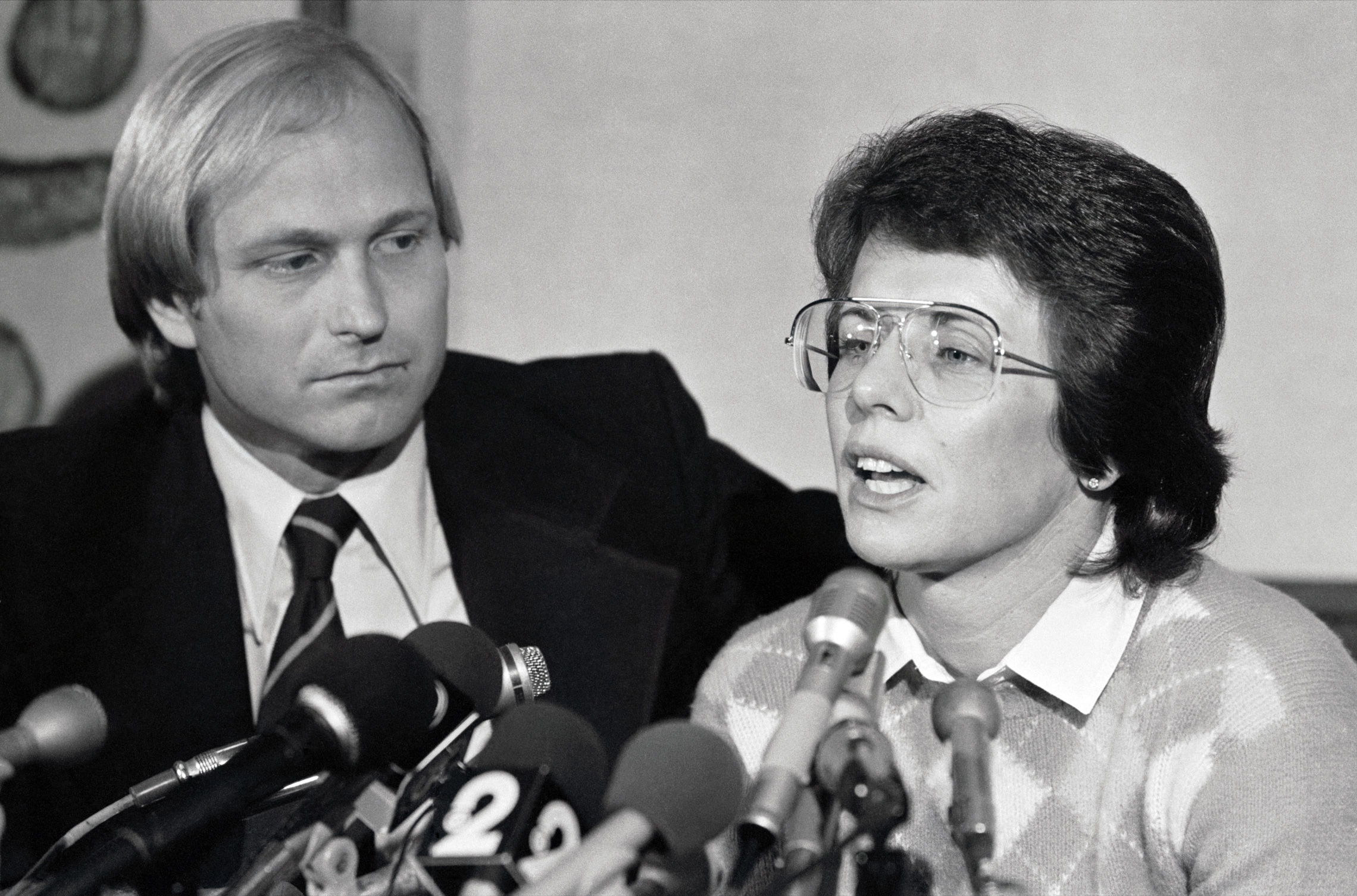
Then, in 1981, Billie Jean’s world turned upside down. Marilyn Barnett, her former hairdresser and secretary, with whom Billie Jean had had a secret relationship years earlier, filed a palimony lawsuit that made the relationship public. The suit was dismissed in 1982, but Billie Jean lost her lucrative endorsements, a massive financial hit.
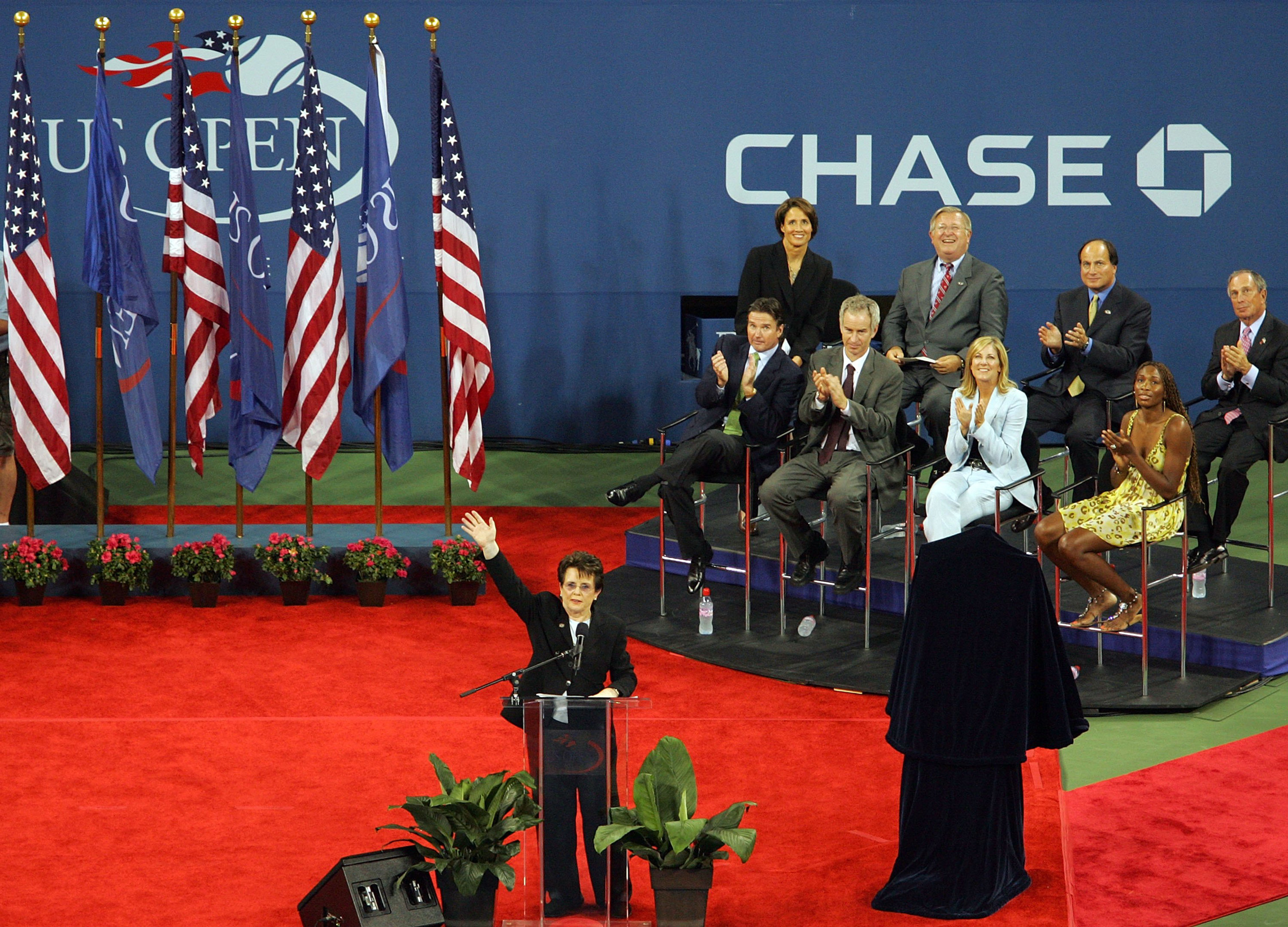
She and Larry, who had remained a close supporter of her career, divorced in 1987. It would be the 1990s, when she was in her fifties, before she felt comfortable with being gay. She said the mental strain of this period was so intense that it contributed to her eating disorder. She threw herself back into her advocacy, working not only for women but also for LGBTQ rights.
On the court, she kept competing in singles into her late thirties, reaching the Wimbledon singles semifinals in 1983 at age 39, and played doubles until 1990. In all, she won 39 Grand Slam titles – 12 in singles, 16 in women’s doubles, and 11 in mixed doubles. She was inducted into the International Tennis Hall of Fame in 1987, and later captained the U.S. Fed Cup team and coached the U.S. women’s Olympic tennis team in 1996 and 2000.
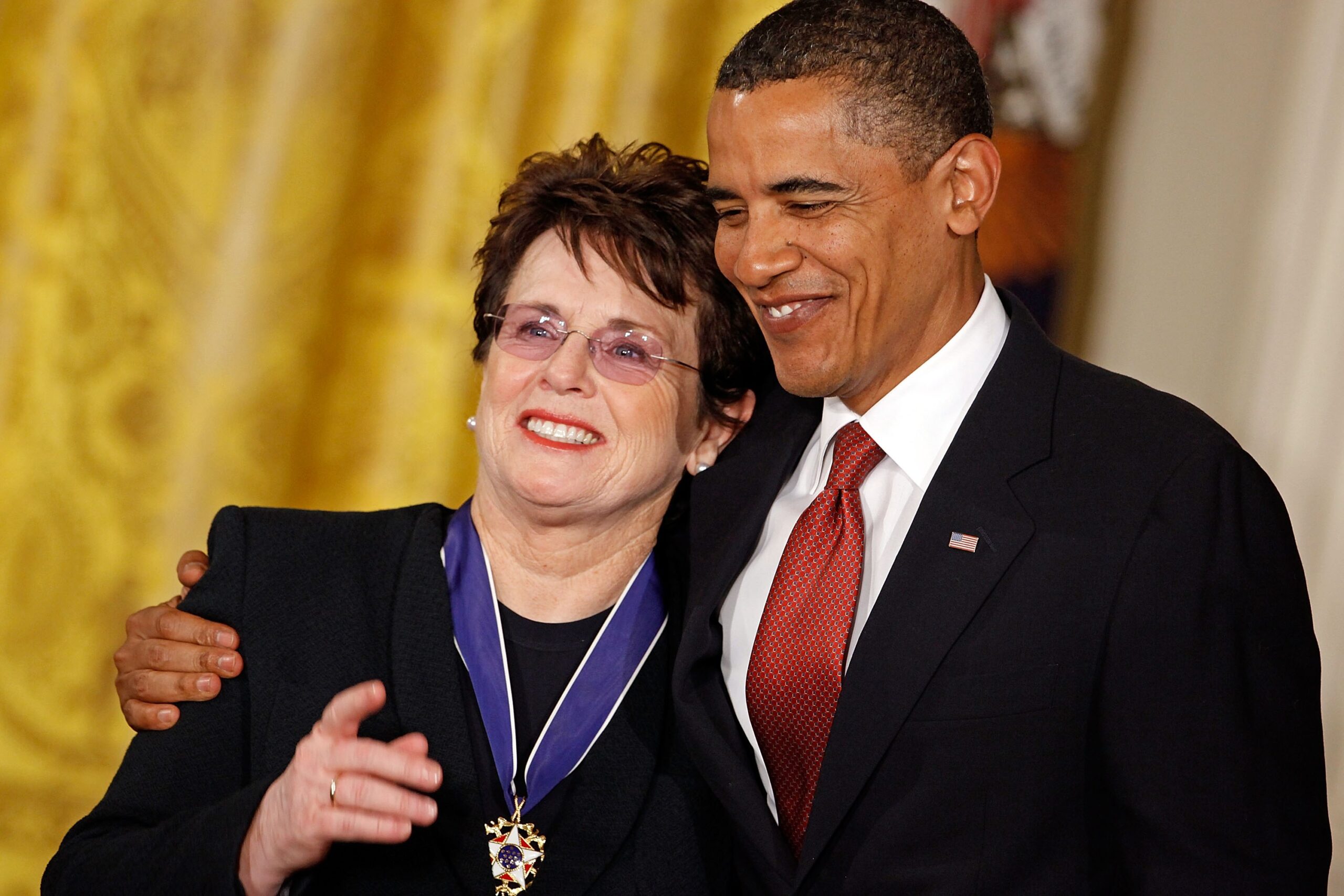
The USTA National Tennis Center at Flushing Meadows, home of the U.S. Open, was renamed in her honor in 2006. President Obama cited her advocacy work when he gave her the Presidential Medal of Freedom, the nation’s highest civilian honor, in 2009. She married her longtime partner, Ilana Kloss, in 2018. In 2020, the Fed Cup, the women’s international team competition, was renamed the Billie Jean King Cup.
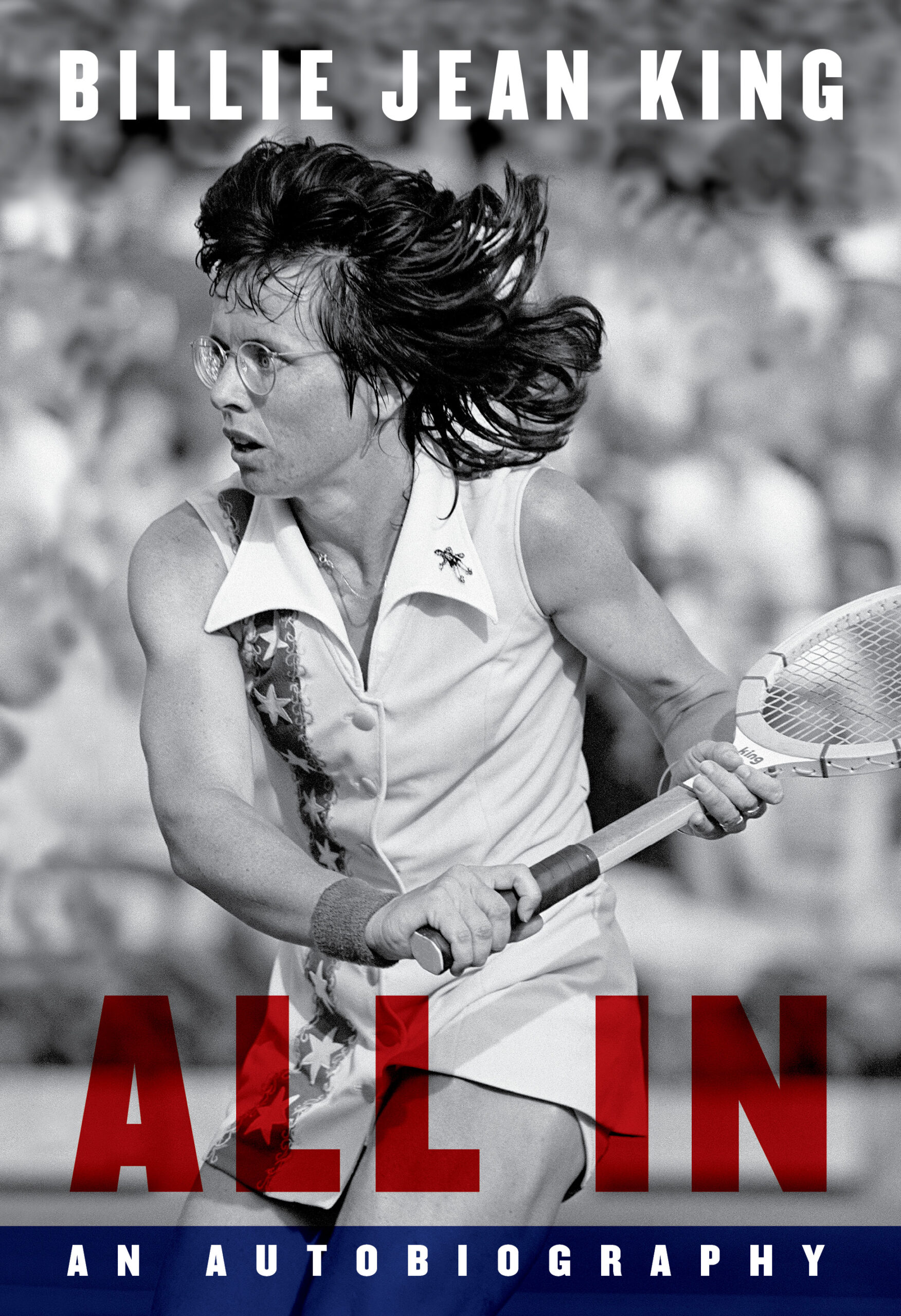
Her hometown named its main library the Billie Jean King Main Library in 2019, and Cal State LA unveiled a statue of her in 2024. Her memoir, All In, was published in 2021. A part owner of the Los Angeles Dodgers, the Los Angeles Sparks, and Angel City Football Club, she also recently helped launch the Professional Women’s Hockey League.
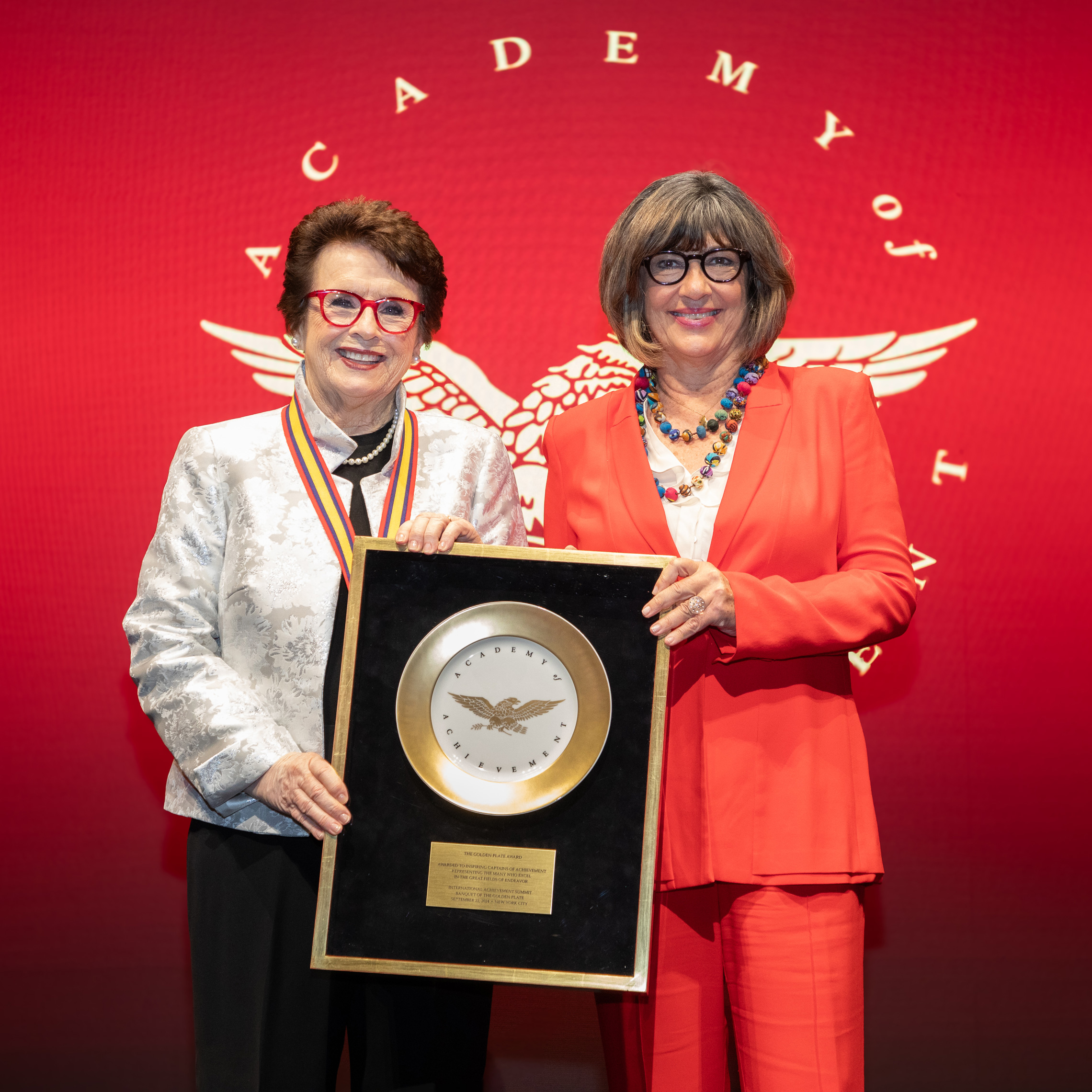
In May 2026, at age 82, she finished her studies and earned her bachelor’s degree in history from Cal State LA. After the ceremony, she told reporters, “It’s never too late, whatever age you are, whatever your abilities are, go for it if you want it.”

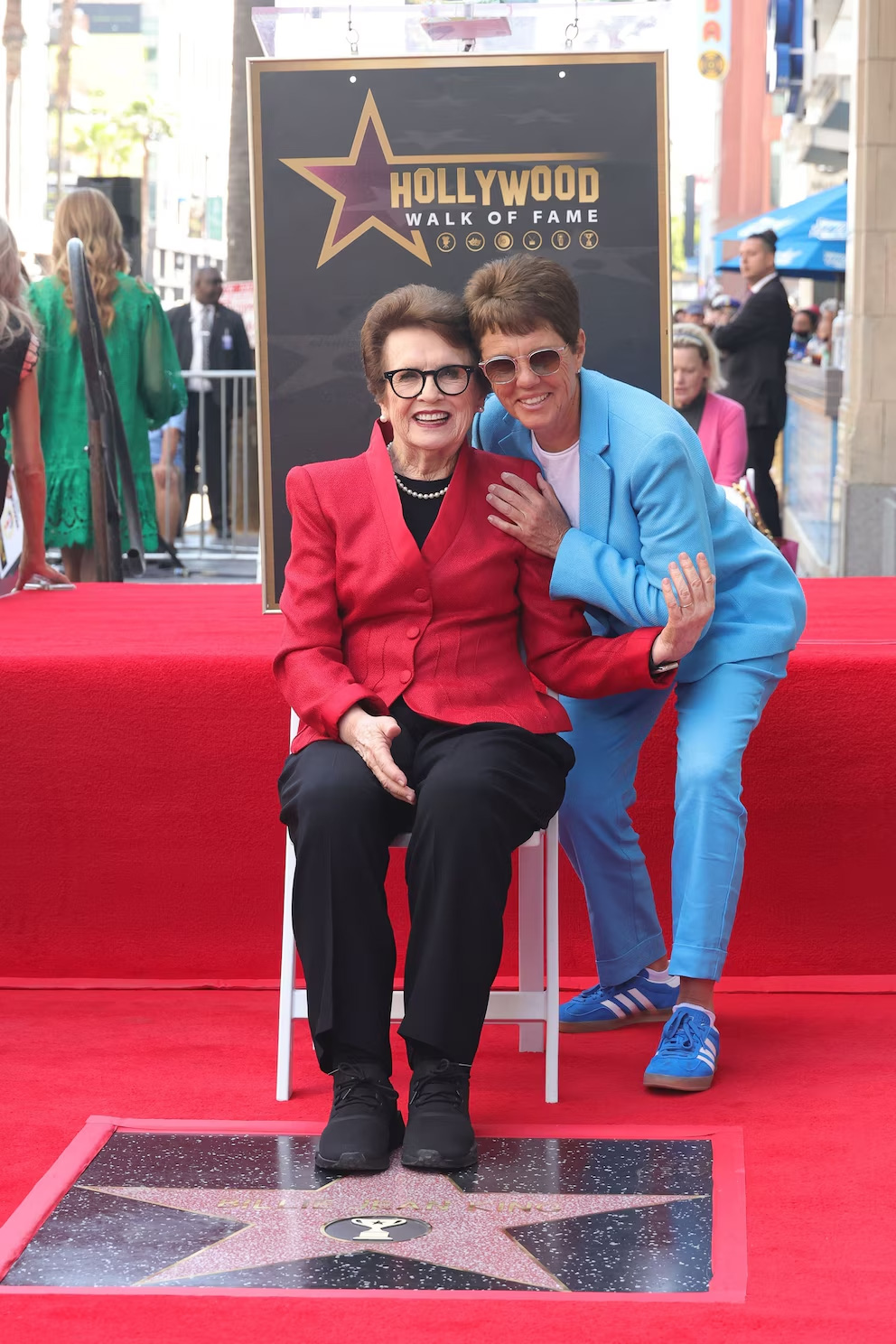
Billie Jean King won 39 Grand Slam tennis titles, 20 of them at Wimbledon. The daughter of working-class parents, she made her way in a wealthy, male-dominated sport. Along the way, she changed the game, playing a leading part in convincing the world that women’s sports deserved an audience and equal pay.
She learned the game in free lessons on the public courts of Long Beach, California. Even as a child, she had resolved to be the best in the world, and by 17, she had won her first doubles title at Wimbledon. She left college to devote herself to tennis, and in 1966 she won the first of her six Wimbledon singles titles.
These victories came within a system that treated women’s athletics as secondary and paid women accordingly. In 1970, she became one of the Original 9, nine players who signed symbolic $1 contracts to start a women’s tour of their own. In 1973, she helped found the Women’s Tennis Association, and the U.S. Open began awarding men and women equal prize money. That same year, an estimated 90 million people worldwide watched her win the Battle of the Sexes against Bobby Riggs, a 55-year-old former Wimbledon champion who boasted that he could still beat the best women in the game.
She was outed in 1981 and lost her endorsements within 24 hours. In the decades since, she has become one of the most prominent advocates for LGBTQ equality in the United States. She received the Presidential Medal of Freedom in 2009. Today, the home of the U.S. Open bears her name. She helped launch the Professional Women’s Hockey League in 2023, and in 2026, at 82, she completed the college degree she had set aside more than 60 years earlier.
Growing Up in Long Beach, California: Family and Early Influences
Billie Jean King: At birth, my brother and I, both of us, our third word that we learned was “ball.” Ball, daddy, ball, daddy, mommy, ball, ball. So anything to do with a ball — which tennis has a ball — I’m there. That’s why we played basketball first, because my dad was a basketball player. He’d been asked by the NBA when he was getting out of World War II to join, and it was just starting, a brand-new league. And he did not, because his — my dad’s generation was really risk-averse. They’d been through a Depression, World War II. My mom had just had her baby, and he wasn’t there.
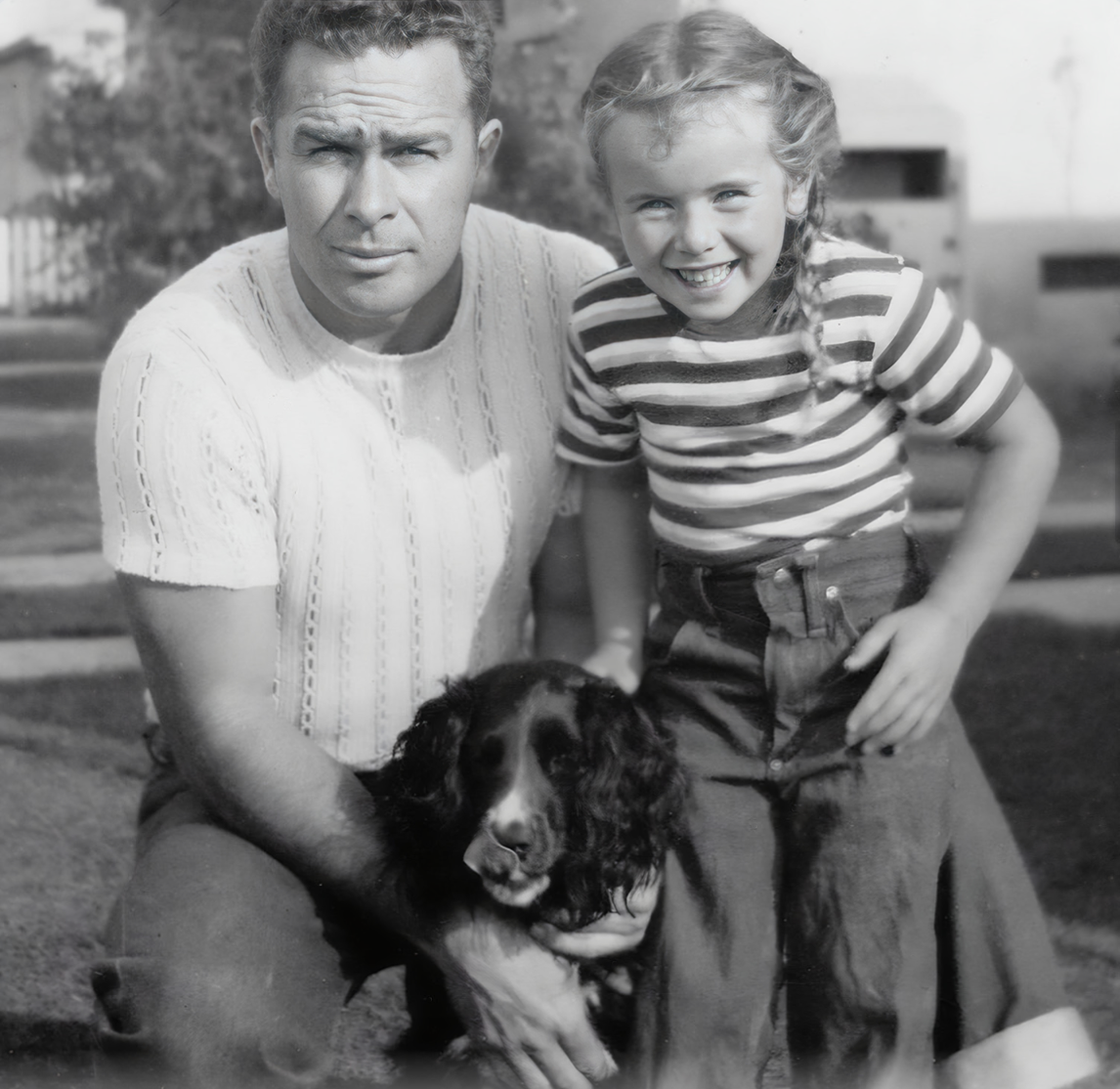
And he wanted to get home to my mom and me. He was a really good athlete. We loved sports. My mother did not talk to us about herself, because in those days it was always about the dad. And I yelled at my mom later in life. I said, “Mom, why didn’t you talk to us about what you liked, swimming and running?” And she said, “Well, I wanted your dad to have all the attention.” That is such a 1950s family. You know, it was always about dad being the one. And she, my mom, she spoke up if she really cared, but she always tried to defer everything to my dad as far as any kind of good attention. Actually, I didn’t meet my dad when I was first born. My mother showed my dad my photo, and then she showed his photo to me. And she said, “This is your daddy. This is daddy.” So when he walked in the door, I went, “Daddy! Daddy!” So you can see that we got along forever because of that. No, because I’d been looking at his photo. I think when I really saw him for the first time I was like two or two and a half, because of World War II. He was in Norfolk, Virginia, getting the guys ready to go overseas, because he did all the physical instruction with them. And he did every exercise with every group, every eight hours a day. And so my mom said he was so thin from working out with them and helping them. But he always told me, “You know what? I couldn’t expect them to do it if I didn’t do it. I’m their instructor.” I go, “Dad, what if they’re like the fourth or fifth group?” He goes, “It doesn’t matter. They don’t know that.”
Discovering Tennis: First Racket and Early Lessons
Billie Jean King: First of all, my dad and mom wouldn’t get me racket. They said I had to figure it out. So, I went to the neighbors and pleaded with them, and they were very sweet to me. They gave me quarters, dimes, nickels. I had a mason jar up in the cupboard. I put all my money in. I had $8.29, and I couldn’t wait any longer. I’m just jumping up and down: I have to get my racket! And my dad says, “Okay, we’ll take you now.” That’s good. We figured out how to do it. That’s very good. And so we went to Brown Sporting Goods in Long Beach, and I got my first racket, and I chose it because it was purple, and I love the color, you know — violets, purples. My mother loves it. Um, and so the, the handle, the strings, were all purple. Very low-end racket, you know. Wasn’t very high quality. Didn’t matter. I thought it was beautiful. Slept with it.
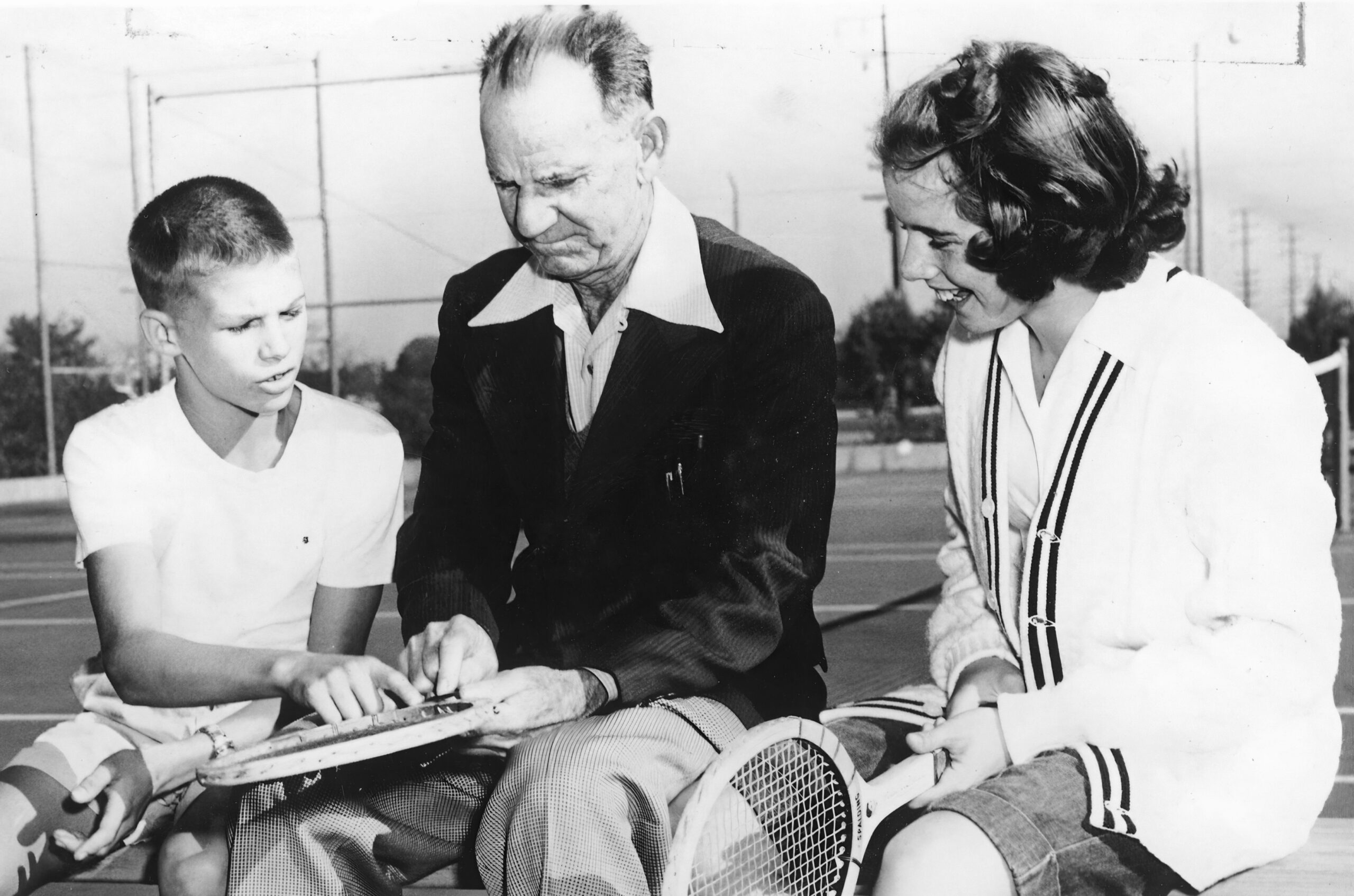
And so I finally get to go. Susan and I played on a softball team, and she told the coach, Val Halloran, “Oh, I took Billie to play tennis.” She goes, “You did? That’s great. They give free instruction here every Tuesday with Clyde Walker.” Now we’re talking. I knew that I couldn’t play tennis, probably, because Susan played at a country club, and that’s where we played for the first time. And as we drove into this country club, I’m like, “I’m not playing tennis.” “Why?” “No. “We can’t afford it, if this is the way you have to go.” So playing softball and having Val Halloran, the coach, say that — now we’re talking. Now maybe I can at least try.
Natural Talent, Vision, and Focus
Billie Jean King: God gave my brother and me extra. We were given extra in our coordination, but also our eyes. I know I wear glasses; that’s a whole other discussion. People said I couldn’t make it wearing glasses, so I couldn’t be number one. There never been anybody number one. I said, “Well, I think I will be.” But I’m 20-10 with my lens even today. And my brother had great eyesight. With my glasses I see unreal, I can still see unbelievable. And when I got to hit, I can see the ball, I just see the ball really well. Granted, my brother and I have really good reflexes, really quick, quick eyes, quick eyes. Watch the ball well, track it well. You have to be able to track it all the way to the contact point to be really great. In fact, 50% are missed at the top level because we don’t watch it all the way to the contact point. We watch it maybe when the ball gets 3 or 4 feet out; before it gets to you, we start raising our eyes or our head to look where we’re going to hit it or what we’re going to do.
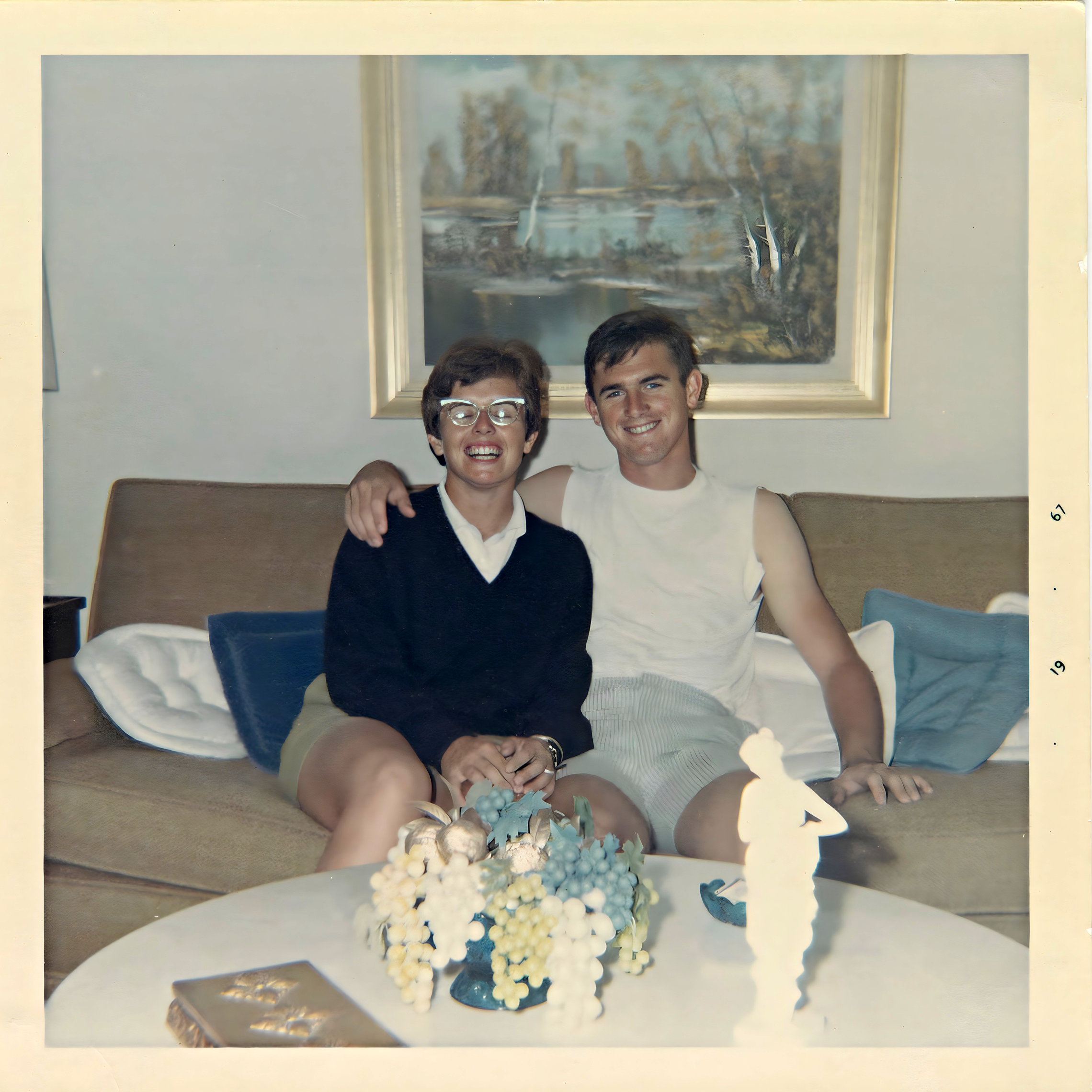
We start — And then golf they talk about, which I don’t play at all, but they talk about still eyes, being still, like watching the ball, keep your eyes still on the ball. So, those are really basic things that Randy and I were given, plus I was quick. Like, lateral movement. I had a good vertical jump. And I loved running, I just loved it. But you also start to realize, I think when I was growing up, people think you’re stupid if you played sports, and that’s not true at all. Usually the top players or top athletes are very much into a lot of things and study things and are very picky, almost OC, you know? If you look at them when they change sides, when you see when they change ends in a tournament, just watch what they do at the bench. They get the water bottles and they’re real picky in how they, they’re in alignment, and they have their rackets a certain way, and then they have no — it’s all very much the way they have to have it. They get very prepared, very prepared, very picky, very selective, very — They know what they want, they’re organized, they’re focused. They put a lot more time in than a lot of people.
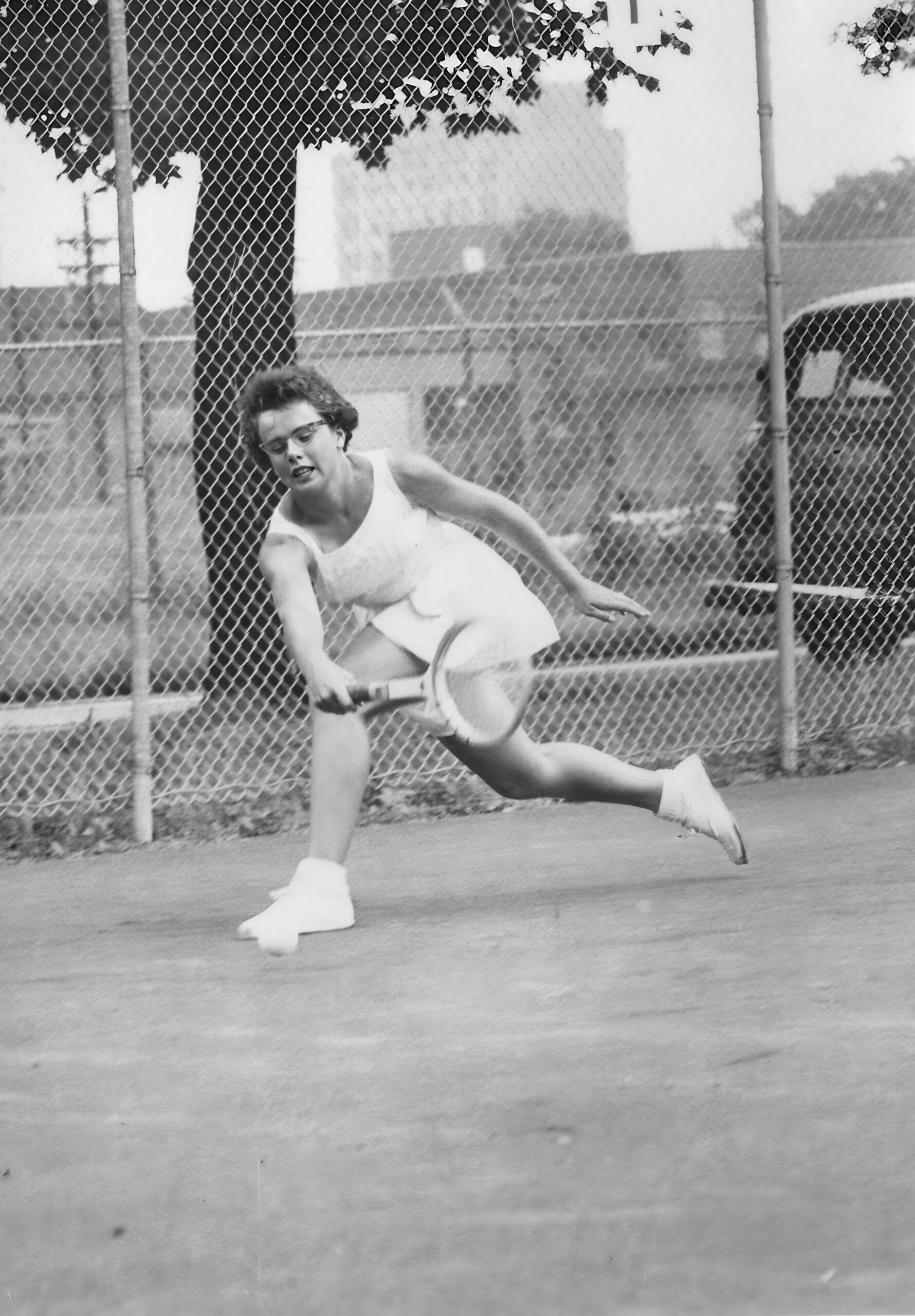
And you read a lot, but you know I loved history, so I immediately was reading all the great books on tennis. Well, most of the books were all about men, and usually it’d be all men, and one chapter might be on the women. So I always promised myself that if I ever got good enough, I’d make sure that we had some books on women players as well, which I’ve done.
Finding Her Destiny: The Dream to Be Number One
Billie Jean King: That first time I went out to see Clyde Walker with my new racket. Uh, it was at Houghton Park, which is next door to Jordan High School, which I did not go to. I went to Long Beach Poly. Um, I walked in; I met Clyde Walker, who I adored immediately. That, that helps a lot. Hospitality really helps. Um, at the end of that hour, hour and a half session, I knew I wanted to be the number one player in the world. I knew I’d found my destiny. I knew I want— I knew exactly what I wanted. And my poor mother came to pick me up. I go, “Mommy, mommy.” And I’m jumping up and down on the seat, which we’re not allowed to do. Uh, I go, “Mom, mom.” I go, “I found what— I found out what I’m going to do with my life.” And she goes, “That’s nice, but you have homework. You have all these things.” I go, “Mom, you don’t get it. This is it. This is it. I want to be the number one player in the world.”
Billie Jean King: I’d already read books, and I love books, I love history, so I knew that tennis was global, that it was played all over the world. And I knew the men and the women both played, which I really liked. I didn’t like, you know — sports are usually just for a guy, or certain sports are maybe for a girl. I don’t like that. I like the fact that tennis had both men and women; that was very important to me. And I was off on my adventure, but I read everything I could get my hands on.
The Day She Dared to Wear Shorts
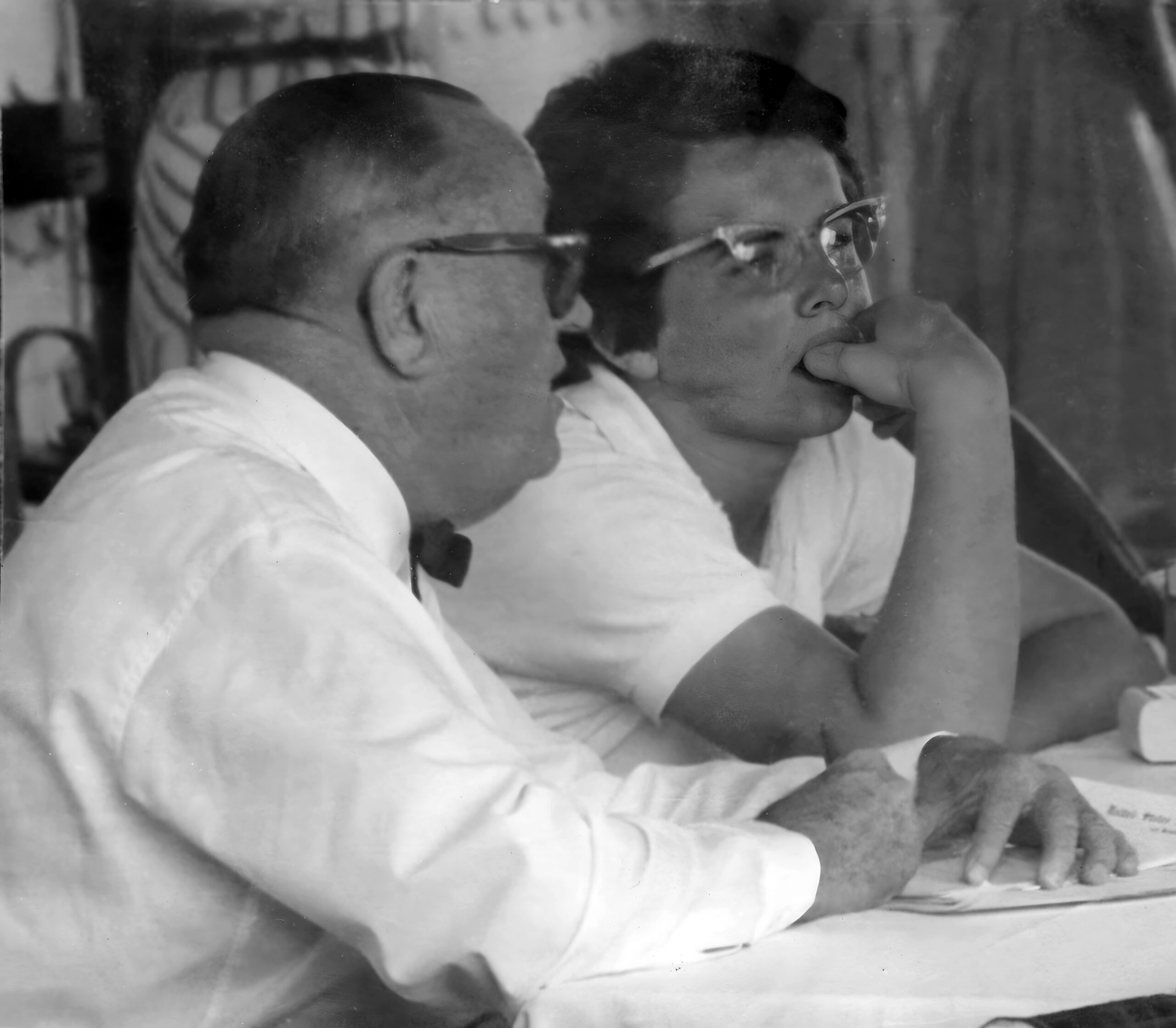
Well, I’d been playing for a year, and then there’s a chance to try to get a ranking, you know, start seeing how good you are in Southern California. We had different sections, and Southern California is a section. So you go to these different tournaments in your section to start going up the ranks. And the Southern California Championships are at the Los Angeles Tennis Club. So my mother reads, you know, what do you have to wear? She’s all concerned, so she sewed me some shorts, and I wore a white blouse, and you had to wear all white, so she was really — okay. You have to wear all white, really important, which I did not like. I thought that was stupid. I still don’t like it. I’m always arguing against it. So we go, and they go, “Oh, this is going to be great.” They have a photo of every kid in the tournament in front of the clubhouse out front. And I go, “Okay, this will be fun.” My mother’s all excited. And so I get lined up, and Perry T. Jones, who is the czar of tennis, comes walking out and says, “Little girl, you can’t be in the photo. You’re not wearing a skirt or a dress.” I’d never seen a dress or a skirt until that day, you know.
Billie Jean King: You know, he’s really strict. So, I got out of it. My mother is mortified because she thinks— My mom thought, “Oh, I mean, I read the rules. You’re supposed to wear all white. I had no idea about a tennis dress or, you know, a tennis skirt.” And of course, I’m thinking, this is not a way to get a child into tennis. I’m thinking, you are so— I probably said stupid in my head, but I said, “Mommy,” I whispered to her. I remember I went over and talked— Well, I talked softly. I go, “Mommy, don’t you worry about this. We’ll show him someday.” Just— “Oh, I’m just so sorry I didn’t do it right for you.” I said, “You did it great. The rules say all white. I’m wearing all white.” I said, “Don’t worry.” In my head, I’m thinking, I’m going to be number one someday, and I’m going to wear whatever I want, and you better let me in the— you know, I’m like getting all riled up. And so my mother’s— So that night, my mother went home and started, uh, sewing a dress for me. And my brother and I talked the other day, and my brother Randy goes, “You know, you remember when mom was down on the floor with the cup making scallops on your, on your hem of your dress?” I said, “Yep, I— yes, I do.” I’ll never forget that night as long as I live. I was so angry, though.
From Juniors to a Bigger Vision
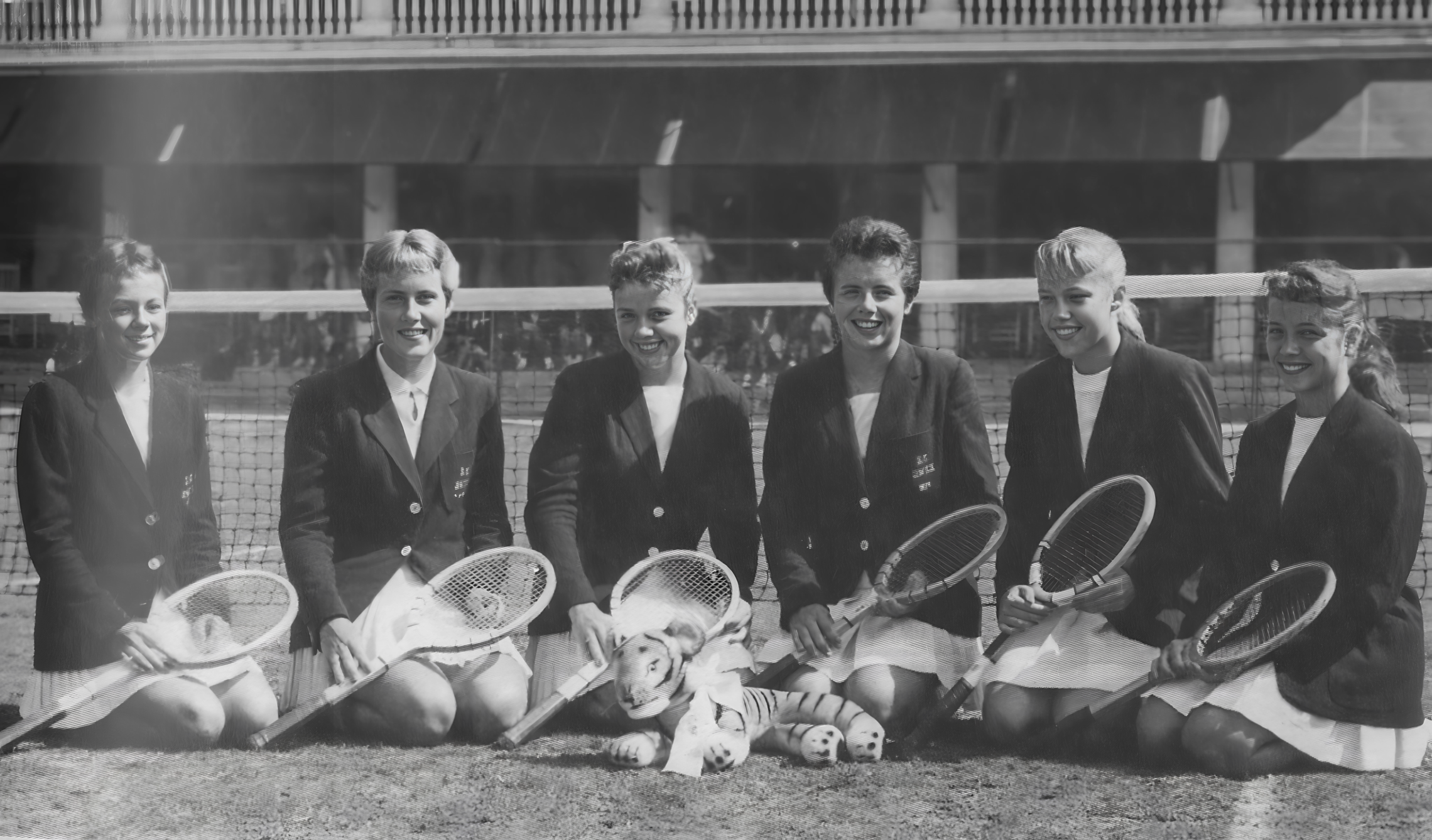
Billie Jean King: The good thing was that I was never the poster child. It was Karen Hantze, and she was on the front of Life magazine at 10. She was the one. And there were about— we had a Wightman Cup team together in the juniors. I was probably number four out of those. Karen would say I was number three, but we voted, and I voted myself number four. She was so angry with me. “You’re number three. You shouldn’t have done that.” I said, “That’s okay. I don’t really care. If I’m gonna be great, that’s going to be minor.” Um, but I decided when I was— when I wanted to be number one, that every match I won, I didn’t care about the juniors. What I cared about is every match was a stepping stone to being number one in the world. So, every time I could win a match, I didn’t care if it was 13 and under, 15 and under, 18 and under, that every time I won a match was really going to be the stepping stone to help me be number one as an adult. So, junior tennis for me personally was very secondary, because my heart and mind and thoughts were on being number one as an adult.
Faith, Mentors, and Life Lessons
You know, you have to understand, when you have Reverend Bob Richards as your minister — from the time I was about 11 or 12 or 15 — Reverend Bob Richards won the bronze in ’48, the gold in ’52 and ’56, in the pole vault. He was the guy that used to be on Wheaties all the time. He was a motivational speaker. I’d go to his sermons on Sunday. I knew it was meant to be when I had him as my minister. I’m going, “Oh, he’s such —” I used to watch him practice next in this dirt field. He had a pole vault thing set up. He had hurdles. He was very important because of how he was such a motivational speaker. When you would hear his sermon, it usually always had sports in it, and you think you could do anything after you hear Reverend Bob Richards. Now, but I heard he became mega-right or something. I’m just like, I don’t want to know. I swear he used to bring Blacks to church with him, but maybe I’m guessing. I don’t know. I just loved his sermons. If you look him up to this day and hear him speak, you think you can do anything. You’ve got to imagine: 11-12-year-old girl listening to this. It’s a Church of the Brethren, which is very low-key, wooden, no ornamentation. Christ is not on the cross. Do not believe in that. It’s between you and God as an individual. It’s like the Mennonites or whatever, I think. I don’t — it’s like — all I know is people were very kind and good, very basic. Don’t drink, don’t smoke, just things like that. My dad said, “If you want to be a great athlete, do not drink or smoke.” And I’m a goody two-shoes with my dad, absolutely. My dad said that, I’m there. I’d say I’m spiritual, I wouldn’t say I’m religious.
Billie Jean King: If you look at my life, there’s no way you couldn’t be at least somewhat spiritual. There’s no way. It was in— It’s like you feel like it was in the stars. It was in the— It was— Look at— Just look how I thought as a child. I mean, it hasn’t changed that much either, I guess. Um, I think my— I think my brother and I got really lucky with our parents. They never asked us if we won. And I still think that this is one of the strongest messages I can send to every parent. Don’t ask your child if they won. Don’t say it. Like Evonne Goolagong’s a perfect example. She’s indigenous Australian. Um, her mother would always say to her, “Have a lovely day.” She’d come home after her match and she’d say, “Did you have a lovely day?” She was also number one in the world. You talk to number ones, I think they got really lucky usually with the people around them, their parents or whoever raised them. Um, they can either work at the opposite or with them, but like my— I would go crazy when I lost. I— I mean, I— my brother and I are not sweet little quiet. No, we’re like— I said, “I can’t believe I lost.” And ranting and raving. My dad goes, “Hold on. Hold on. I’m just gonna ask you one question. Did you try your— your very best?” I go, “Of course I tried my best.” He said, “That’s good enough.” He said, “You might have to ask yourself, are you practicing enough? Or maybe you’re practicing too much?” “Too much?” “Yeah, you’ve burned yourself out. Maybe.” “I don’t— Yes, you have to ask yourself these questions.”
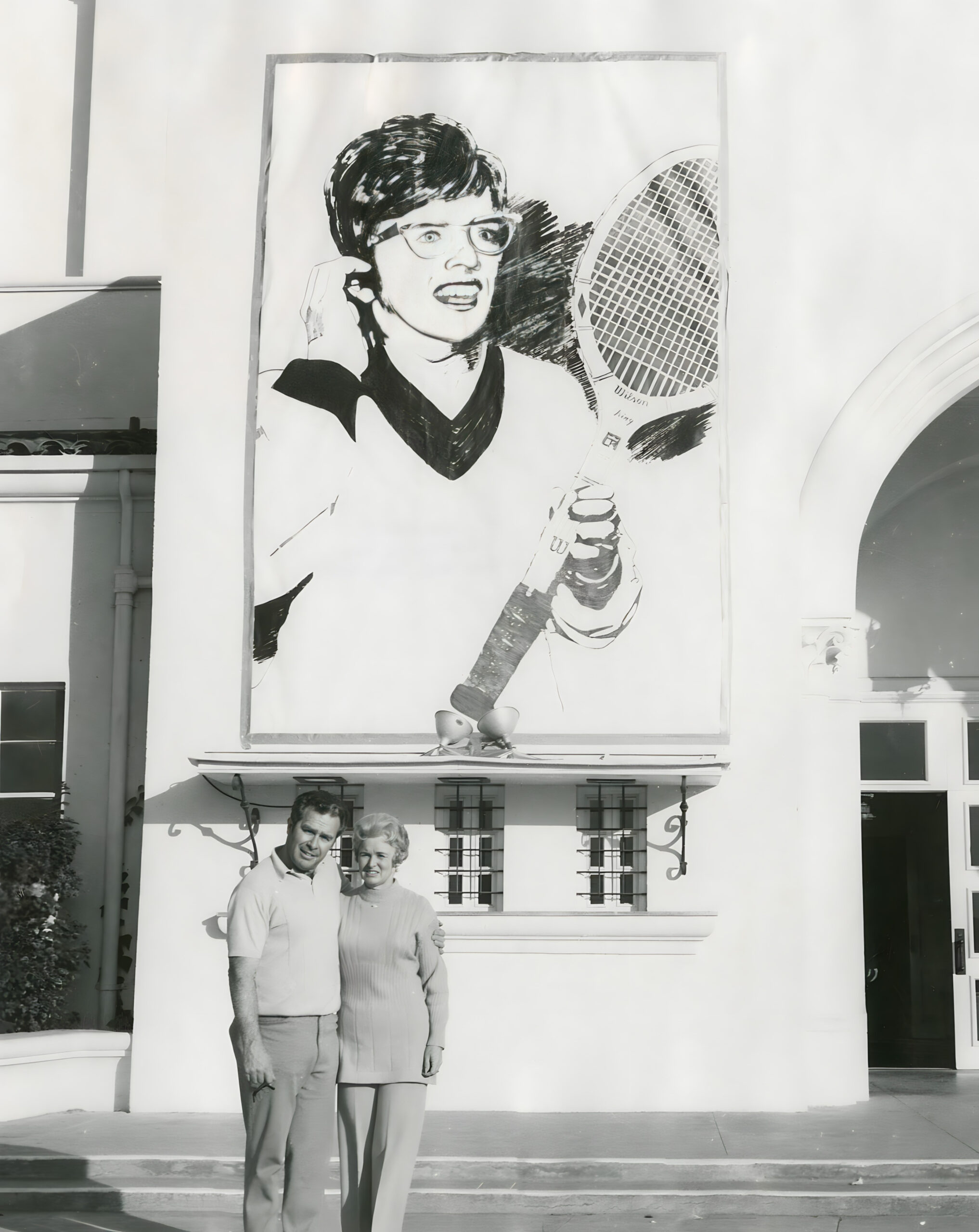
But if you think about my dad, what he did is he helped me with delayed gratification. He wouldn’t buy the first tennis racket I want— wanted, right? Well, go back to when I was three years old. I wanted a baseball bat. And he says, “No, I want to know if you really love it or not.” So he took a 2×4 and cut out a paddle for me. He says, “And I’ll pitch to you every day, whatever, whenever I’m home.” As a firefighter is home every other day, which is another really helpful thing. So I go, “Okay.” So I would hit for three hours in a row. My poor guy— dad. But look at— my dad would stay there for three hours with his children. And so with me— my brother hadn’t been born yet. So anyway, I’m hitting. I’m hitting every day. My poor dad. I’m like, “Daddy, daddy, let’s go play. Let’s go play.” So finally he stops. He says, “You know what? I can see you love it. I will buy you a baseball bat now.” But my dad was teaching me, and I don’t know if he realized it, but he really taught us delayed gratification. Like when you want to be the number one in the world, there’s a lot of delayed gratification. A lot. And that’s if you even are fortunate enough to, to be able to be up at number one. What about the kids that never make it to number one? Maybe the number 100’s their best. That’s great. It’s— everyone’s different. We’ve all been given different abilities. We’ve had different circumstances. I got really lucky. And Reverend Bob Richards was one of the lucky parts of my, my path.
I know when I told him, he said, “What do you want to do or be?” And I go, “I want to be number one tennis player in the world.” I knew, deep in his heart, in his eyes, he didn’t think — like, this little chubby kid, whoa, like, that’s really asking for too much. I think he might have used this in his sermons later, though, after we won. Like Karen and me, I think he used in a sermon: the little chubby girl did okay.
Learning Through Losses
Billie Jean King: Everybody loses, that’s for sure. And when you’re a junior, you lose a lot. Um, no, because it’s what I can learn. You just got to keep learning all the time. And I tried to play more like an adult, not a junior. Juniors, the way they would win is just be steady and throw the ball up and just be steady. And in those days, you didn’t have— when you were younger, you didn’t have the power. As, as you— as you got older, you had more power. So, I didn’t want to play like that. I was going to serve and volley. I was going to be aggressive. I was going to go to net. And I might lose as a junior, but I was still going to keep learning and keep getting better. And that was my goal. Everything— everything for me was being, where do I compare as being a number one in the world adult? Not a junior, unless you’re a junior and can be number one in the world, which you can. Tracy Austin was 16 and was number one in the world. Chris Evert was probably 17 or 18.
1961: First Wimbledon
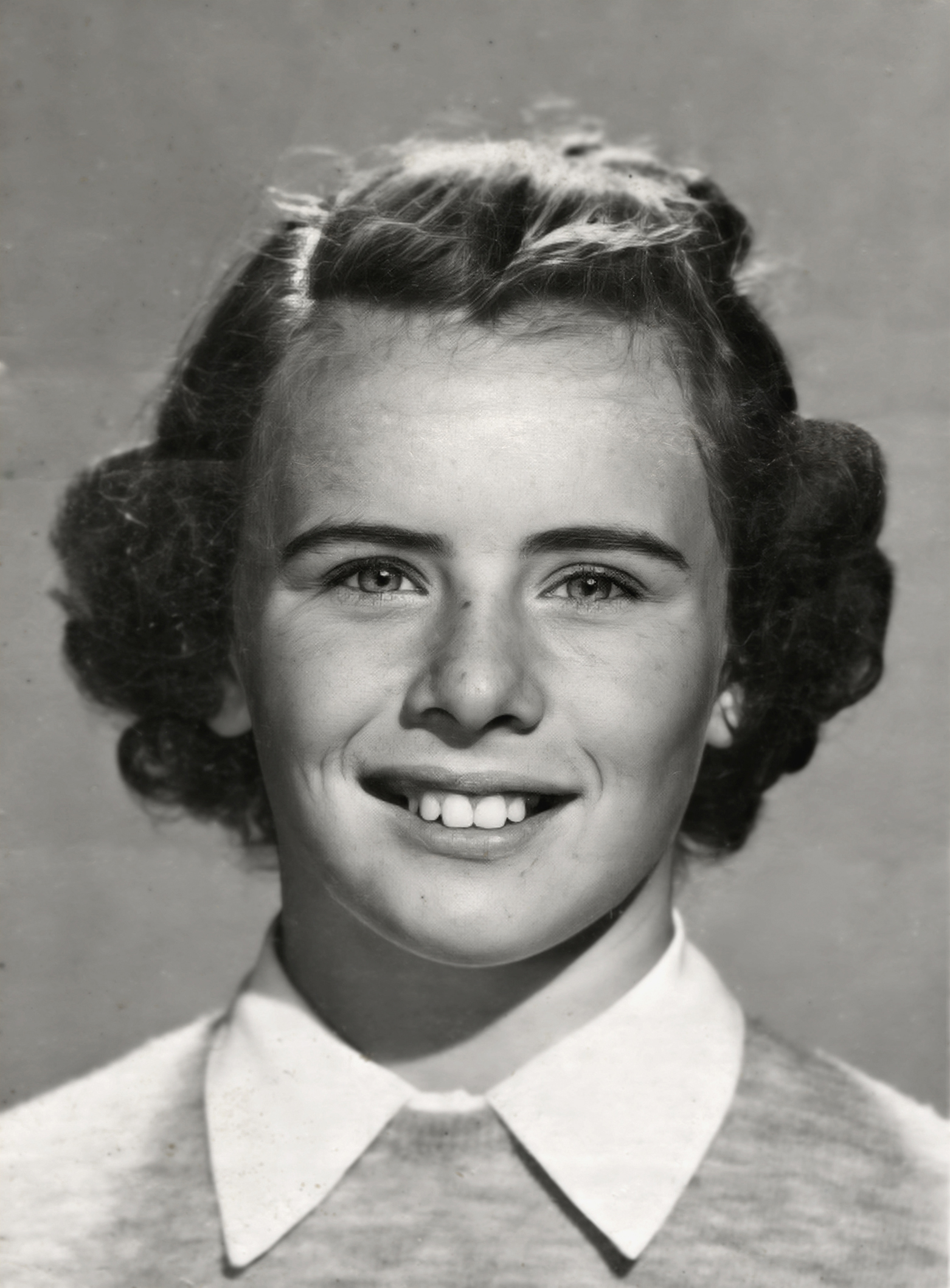
Karen asked me — I thought I was going to faint, because she’s from San Diego and she always played with Kathy Chabot. I played with Carol Caldwell. And Barbara and Pam were the six on the Wightman Cup team. Played together because we’re from near each other and good friends. So how did Billie get to play with Karen?
Billie Jean King: Well, Kathy decided she wasn’t going to go to Wimbledon, or if she did go, she’d only play in the juniors. The first year I went to Wimbledon, they didn’t allow us to play both the juniors and the adults. And this is where Perry T. Jones really helped me. He calls me into his office. Now, I think I’m in trouble automatically. And he goes, “Wimbledon has just changed the rules. You cannot play both the juniors and the adults.” I said, “I can’t?” Because I had planned on doing that. He said, “No.” I said, “What do you think I should do?” And he said, “You should play in the adults.” That is the greatest thing Perry T. Jones ever did for me. Besides— I mean, he didn’t do— he was, he was rough on everybody, especially the girls. I think we got $14 a day or something. We stayed in a— Karen and I stayed in a one room, six pounds a week. Uh, you got to remember this is 1961. The way people see it today, it was just so different for us. We didn’t have coaching. We didn’t have anything. We helped each other. Uh, we had no money. Uh, Karen and I had $3 when we came home at the end of Wimbledon, and we won Wimbledon that year. But the USTA, the USTA would come to you and give you an envelope of cash to get you through the two weeks, and that’s how you made it.
It wasn’t really enough, but the Long Beach patrons and the Long Beach Century Club helped send me to Wimbledon. Because remember, there’s an airfare there too, to get over to London. And then you’ve got the normal things that people have to go through. But we stayed in this one-room flat. And Mrs. Gordon was head of the whole household. And she didn’t know us in the beginning, so she didn’t give us very much for breakfast. And then as we started to do well and she started reading about us, we got a much better breakfast. I mean, we didn’t get any toast, then we started getting two eggs instead of one. And Karen and I were — and then she started calling us “her girls.” So we thought that was hilarious. We had a good time with that.
Being the Youngest Team to Win Wimbledon
Billie Jean King: Karen, before we played, kept telling me, telling me we could win. I go, “Karen,” she [said] we got to look at the draw.” I said, “I never look at the draw except the night before. Who am I playing tomorrow?” She goes, “No, come in with me.” I go, “No, it’s bad luck. I don’t want to look at the draw.” She takes me over. “We can beat this team. We can beat this team. We can beat this team.” Now, remember: Karen went to Wimbledon the year before, so she’s the vet now. And she’s saying we can beat these people. So here we are at Wimbledon. We’re playing, you know, Margaret Smith and Jan Lehane, and we did beat them, and we were the youngest team ever. Karen was 18, I was 17. And we’re still the youngest team ever to have won Wimbledon.
How did you celebrate?
Billie Jean King: We probably went to a wimpy bar. We didn’t have any money. We had to eat, you know, dinner. But they have a Wimbledon ball, and everybody says, “Are you going to the ball?” And we’re going, “What?” I said, “I’m assuming you have to have a nice dress.” They said, “Well, of course.” And we’re going, “We’re not going.” So Bud Collins, who is a great writer, uh, for the Boston Globe, found out that we couldn’t go to the— couldn’t go to the ball. And he comes and he says, “I’ll take you to dinner tonight. How’s that?” And we went across from— in this basement very near Harrods. And we had an Italian dinner. And he said, “Well, let’s get— let’s get some champagne.” And we said, “No, we don’t drink.” And I always remember Bud saying, “God, this is great. You’re such cheap dates.” You know, it’s like, like so cute. But Bud became a great friend, and uh, I loved him. He was a great guy. He played— he was actually a boxing writer, he loved to write about boxing as well. But he loved tennis.
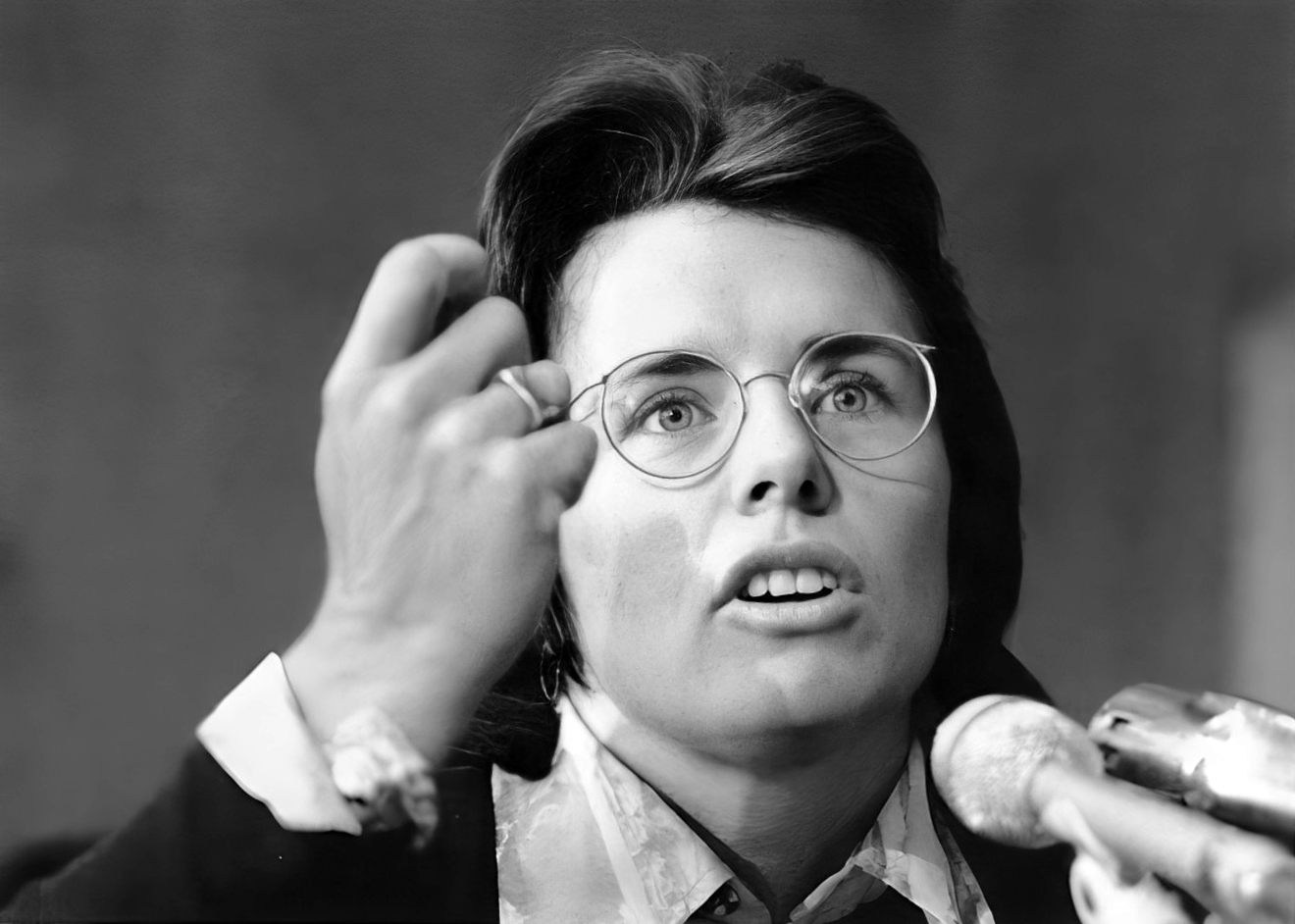
First Wimbledon Singles Title (1966)
I had to quit college to do that. I was married by then to Larry — Larry William. Not — a lot of people say, “Oh, Lawrence,” right? No, it’s Larry. Yeah, Larry King. He was great. So I won my first Wimbledon as Mrs. Larry W. King. Or “L.W.” They put up on the boards where they keep all the winners, and I thought it was great. I was very old-fashioned. It’s fine. I’m okay with it to a point, because I loved him and I thought, oh, this is good, his name’s up there. But he said, “This is ridiculous.” He’s such — he was such a — he is such a feminist. I didn’t get a — pro, what did I get? I don’t think I got anything. Oh, maybe a gift voucher, I think, to — I don’t know. But Fred Perry helped me out to get home. He gave me the money for it. He was a great player. He won in ’34, ’35, and ’36. And he was a great guy. You know, Fred Perry clothes — that’s the Fred Perry. And he gave me some cash to help get home, for the plane ticket. So it’s a very different world now than it was then. But the world I dreamed about as a child, when I started tennis — I wanted tennis to be a professional sport, because “pro” means you’re really good, and “amateur” means it’s a hobby, and we were not — this was not our hobby. This was it. And so I’ve been fighting, and I had a vision for our sport at a very young age. I must have been 12, 13. I had my epiphany at 12. So I was off and running. Plus I love reading about — bio — I love stories about people, biographies. I read biography. I still watch documentaries, biography. I love documentaries. No, no, I’m — I’m ridiculous. I mean, I’m just finishing, uh, Billy Joel — the first, I think the second season’s out now. Anyway, that’s where I’m at right now.
Building Women’s Pro Tennis
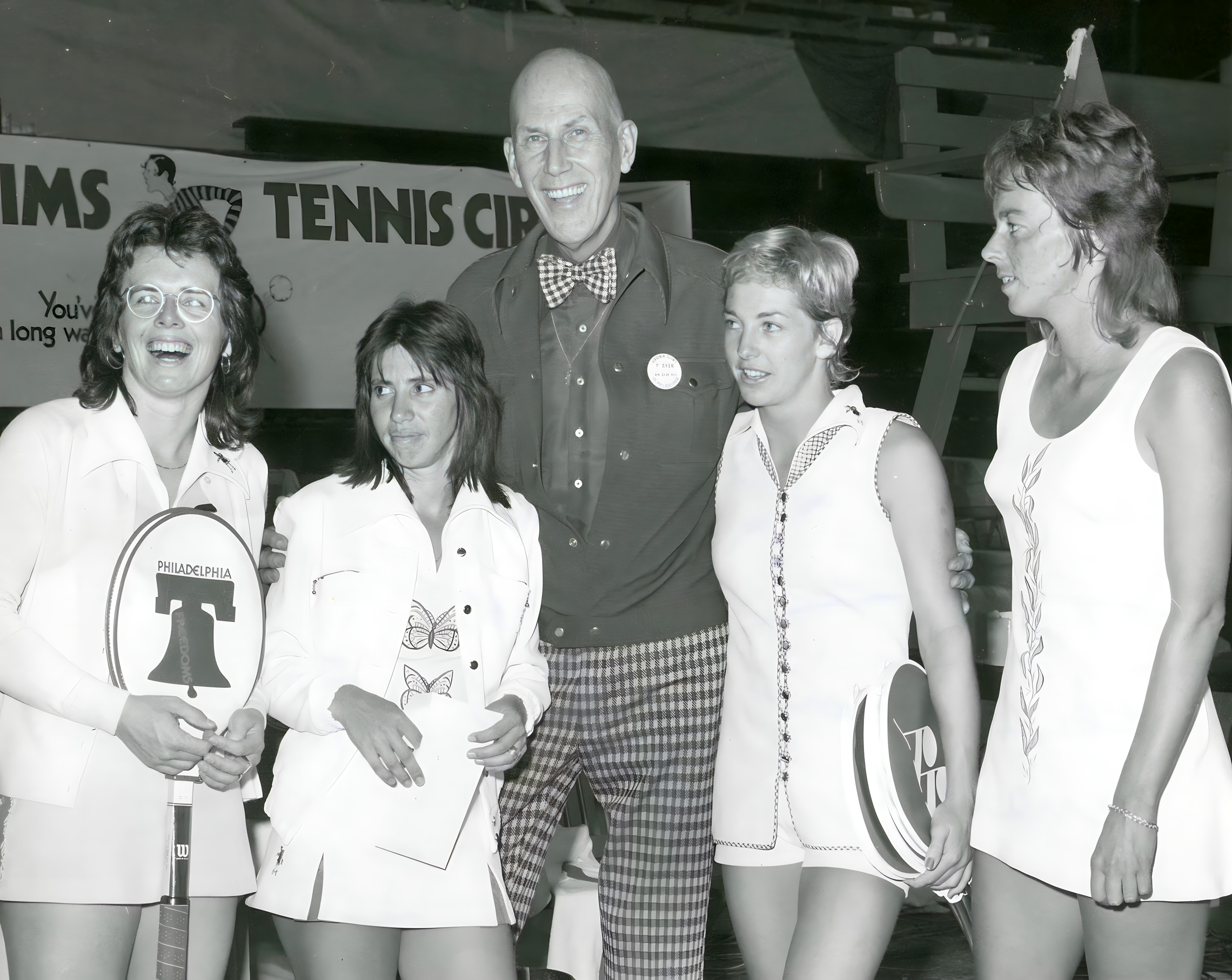
Billie Jean King: Nine of us signed a $1 contract in 1970. September 23rd, 1970, nine— nine players, and we have a very, um, I don’t know if you’ve seen that photo. We’re holding up a $1 bill. That is the birth of women’s professional tennis the way you know it today. That is the birth. The very next year in ’71, we had a tour. We finally had a tour, a lot of tournaments, you know, in one year. And I told Larry in December of ’70, I said, “You know what? If I can win over 100,000 next year, maybe they’ll watch the tour. They’ll keep track every week, and then they’ll get to know all of us players, and then they’ll think about women’s tennis, and then they’ll think—” And the kids growing up will start to see there’s opportunity for them, and I’m thinking about all these things. And so I said, “You know what? I’m really going to try to make a— over a hundred. I think the top male athletes make about 150 or whatever. But if I can make over a hundred, I think we might— we might get noticed. We have to get people to watch us, and hopefully it’ll inspire children to have the dream that they can do it, and there will be a place for them, you know, as a pro when they grow up, not what I grew up with as an amateur.” So, I’m thinking, if we can do all these things— but I— I want to win over 100,000. I don’t know how I’m going to do that, because usually the winner got 1,800 at our tournaments. If you won doubles, it was 500 for the team, so you got 250. So you’re around 2,000 if you can win. That means if you win everything.
And then Gladys Heldman is who we signed the $1 contract with. Because she’s a publisher, Larry said she’ll know all the CEOs, and she knows all the— you know, she’ll know all the advertisers, and that’s what you need to know. You know, that’s how we’re going to make this happen. And Larry and I had already done a couple of tournaments, so I knew what it felt like to be on the other side, not just the playing side— the ownership side of a tournament, which I, I loved. I love business. So, I was right off and running with that. So, I— I had that in my head. We’re starting the tour. Gladys didn’t know how she was going to sign us. I said, “Just sign us up for a dollar as a contract pro, because that way we can legally do that.” And she says, “Well, a dollar? You guys aren’t going to sign?” I said, “Yes, we will.” I said, “That’s my job. I have to get the other players to say yes.” So you’ll see this $1 bill we’re holding up. That’s how that happened, because Gladys goes, “I can’t afford you guys.” I said, “Can you afford a dollar?” Because Larry’s a lawyer— he’s going to law school. So I know that it’s just as binding as a trillion dollars. And she, “You would do that for a dollar?” I said, “Yes, we would. Are you kidding? We’ll sign up with you in a heartbeat.”
We want to be pros. We’re going to get paid. We’ve got to go and get prize money. So we had prize money for one week in ’70. I kept saying, “Larry, Larry, this is great. We have one week. But what are we going to do after that? We need a tour. We’ve got to have tournaments.” She went and got Virginia Slims. We went and helped get promoters. We kept telling promoters, “If you do it, you’re probably going to lose your shirt. But will you do it?” And they said yes. I mean, I can’t believe how great some of the people were that owned tournaments in the beginning.
The Fight for Equality: Title IX and Beyond
Billie Jean King: If you look at Title IX, it’s good for everybody to read. It’s only 37 words. It will not mention classroom quotas, or it will not mention sports in it. But let me explain what it did. To your point, for the first time, for instance, if you wanted to go to Harvard and become a doctor, PhD, you know, get medical— Harvard only allowed 5% of the class to be women. And I used to think in the 60s, “Why aren’t there more women doctors and lawyers?” Bingo. I didn’t know— I didn’t know they didn’t have that law. So, we didn’t have— we weren’t open. So, when Title IX happened, guess what? That opened up everything. Now, girls can go to college as much as boys, or so— What’s happening today? 57% of graduates are women. That’s not good either. We need the boys, we should be 50-50. And men of color are not going to college as much, so we need to get that up a little. But 57% is not horrible, but still— now we’re ahead. That’s not good either. I want us to be equal, and that means 50-50. But then, when we’re fighting, you have to understand, I’m out of college now. So, here’s what happens. The word— there’s the word “activity” in it. And I talked to, uh, Senator Birch Bayh, became friends with him, and we were talking. He said, “Billie.” I said, “Well, who wrote it?” He said, “The four.” He said, “There’s four people that wrote it.” It was him, Patsy makes some other of it, Congresswoman Edith Green, and then Dr. Sandler, who was not a congresswoman, but she was always nitpicking on the law. And she saw where Lyndon Johnson had changed discrimination to include the word “sex.” So now she rushed over to Congresswoman Edith Green and said, “This is our chance to have this law for education now.” So they got rid of quotas, which helped. And then there’s the word “activity,” which Senator Birch Evans Bayh told me they took it out, they left it in, they took it out, they left it in. They didn’t know what to do with this word “activity,” and they looked at each other, said, “Let’s— you know what? Just leave it in. Maybe it’ll be a catch-all or something.” The reason we have athletic scholarships for women in college is because that one word, “activity.” Any activity in school— well, sports were activities. The boys were— had in these activities, and they have all these opportunities. Well, the girls are supposed to have them as well. That’s the reason. We still do not have as many opportunities as the boys did in 1972, when Title IX, uh, was passed, June 23rd, 1972. So, it’s like— even we’re still not caught up. Okay?
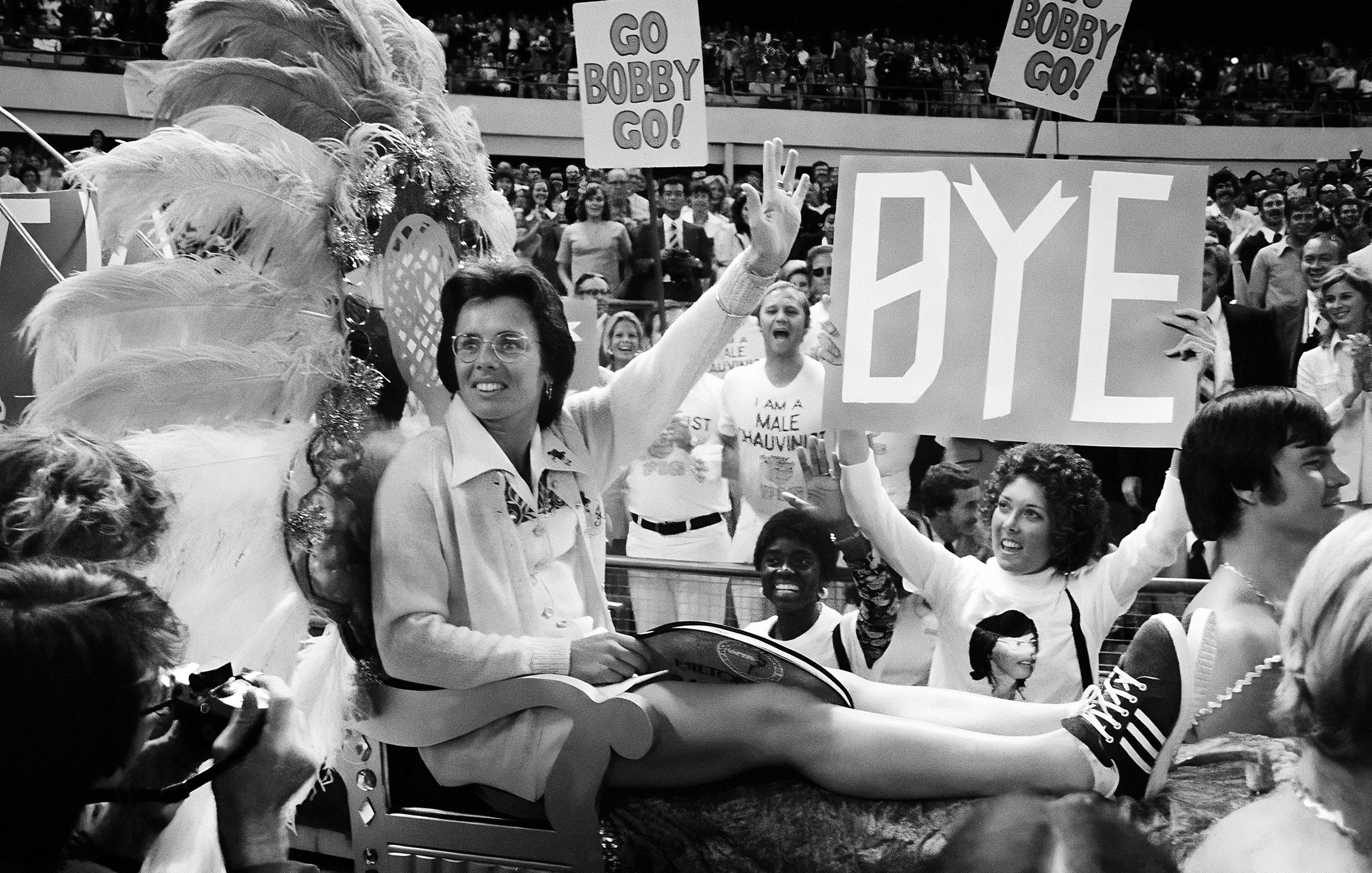
Bobby Riggs and the Battle of the Sexes
I actually — he was one of my heroes too, because I read history. I knew all about him, and I’d seen all the clips on him, but he knew nothing about me, which is also very common: that the woman will know a lot about the guy, and the guy will not know too much about her, because he doesn’t ask her questions usually.
Billie Jean King: It’s the way we’re socialized, okay? Men are socialized to be brave. Girls are socialized to be perfect. You can never be perfect. That’s why we’re never think we’re good enough. The guys are taught to be brave. They’re not going to feel brave all the time. Nobody feels brave all the time. So, the way we’re socialized is really difficult, and that’s what I really study a lot and think about a lot. Um, is the way we’re socialized. And if men and women think about it, the men have the power, actually. They could change it overnight. They’re— the men are the ones who could change sexism and all these things quickly, because they, they still really do have the power. But they don’t have— I don’t think they’ve really thought about what they could do to change the world, to make it a better place, as much. They think about winning and beating somebody, but re— like Bobby, it’s about beating us down. But how can you make the world a better place? And I think if the girls and boys were socialized differently, I think we could do it. I kept saying no. He kept coming back to me. “Billie, you got to play me. You got to play me. We’ll make lots of money.” I go, “Bobby, no. This is not about tennis. This is about much deeper than I cannot tell. Culturally, this is so deep.” And he goes, “Oh, no. We’ll just make lots of money.” That’s how he’s thinking. And I’m like, he doesn’t get it. So, finally, I’m in the elevator at this tournament, and Margaret Court’s with me. Now, she’s Margaret Court. She was Margaret Smith. She’s Barry— she married Barry. He’s a great guy. So, anyway, she goes, “You know, I’m going to play Bobby Riggs.” And I went— I go, “What? Why?” She goes, “I’m getting 35,000. I’m getting a lot— big check. And why not?” I said, “I’ll tell you why. This isn’t about tennis. This is about so much more than tennis. This is about culture. This is about—” I was just crazed. I, you know, I said, “This is about equal prize money. This is about everything.” And she goes, “Okay.” And remember, she’s from Australia, so she hasn’t been socialized the same way American girl has. I said, “You have to win.” And she says, “Okay.”
I told Larry, I said, “Larry, if Margaret should lose — she should beat him handily, but if she should, for whatever reason, then I’m going to play him. And don’t say anything, though. We have to wait until after Wimbledon.” They played in May, and he beat Margaret 6-2, 6-1, I think, or 6-1, 6-2. I had to look it up. Anyway, it’s a kill. Beating Bobby was absolutely — I had no choice. I told Larry, “I have to beat him. If I don’t, it’s non-negotiable.” And I said to Larry, “We can’t announce until after Wimbledon. I got to get through Wimbledon.” We just formed the Women’s Tennis Association. We’ve got Wimbledon. But, you know, I won all three. I do not — I don’t know how I won all three: singles, doubles, and mixed. Go figure. I had Rosie Casals and Owen Davidson as partners. That’s probably the reason we won, because they’re great players. But I still can’t believe I won all three. That’s very rare to win all three titles. It’s extremely rare. I mean, it hardly ever happens. So I win that thanks to Owen and Rosie, and then here comes the King. Here comes Bobby Riggs match coming up.
Pressure is a Privilege
Billie Jean King: I like pressure. That’s what makes me— That’s— If you’re gonna be a jock, if you’re gonna be a champion, what are you g— You’re gonna have pressure every day. People have pressure every day for living, getting enough food on the table. Come on. How many people get a chance to play professional tennis in the first place? How many people have a chance to play Bobby Riggs? How many people have a chance to be in the finals of Wimbledon? How many people— It is a privilege, and it’s what I wanted. Therefore, I appreciate it, and I want it. I want that pressure. I want to be out there. I want to go walk on Centre Court where the past champions have gone and the future champions are going to be out there. What about the people that never even got through qualifying to play on Centre Court? I’m really lucky, man.